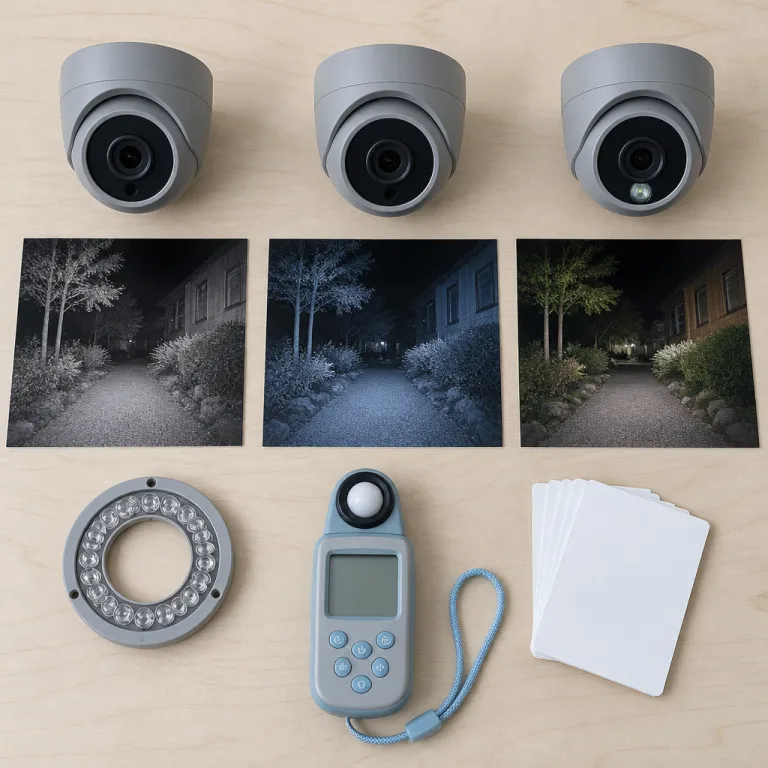
Why security camera night vision comparison matters after midnight
Most people only realise weaknesses in a security camera when a crucial night clip turns out useless. A structured security camera night vision comparison forces you to look past glossy marketing and into how the camera sensor, lens, and infrared emitters actually behave once the light drops. The goal is simple yet demanding, because you want footage that holds up when a stranger walks past your driveway at 03:00.
Every modern security camera promises sharp video, but the gap between daytime image quality and night footage can be brutal. Under low light, the same cameras that look crisp at noon often smear motion, blow out faces into white blobs, or fall back to grainy black and white that hides clothing color and vehicle details. A serious comparison of night vision cameras must therefore focus on what the image sensor does with ambient light, how strong the infrared illumination is, and whether the camera can maintain full color without turning your garden into a stadium.
Think about your own setup and where your security cameras sit today. A Ring Stick Up Cam or Blink Outdoor 4 mounted under a porch roof faces very different night challenges than an outdoor camera watching a long driveway or a dark side path. That is why a real world security camera night vision comparison has to separate indoor camera placements, semi sheltered outdoor zones, and fully exposed outdoor areas, because each location changes how much ambient light reaches the sensor and how well the night vision systems can perform.
How IR, starlight, and color night vision actually work
Under the hood, every security camera sensor is fighting the same enemy, which is noise created when it tries to amplify tiny amounts of light. Traditional infrared cameras use LEDs that emit invisible light at 850 nanometres or 940 nanometres, which bounces off people and cars so the sensor can build a monochrome night vision image even when the scene looks completely dark to your eyes. This is why your footage often flips to black and white at night, because the camera is relying on infrared night illumination rather than visible ambient light.
Starlight style vision cameras take a different route by using larger pixels on the CMOS sensor, which gather more ambient light from street lamps, windows, and the moon to keep a low light color image without switching to infrared. These starlight systems shine in urban or suburban streets where there is always some light, but they collapse into mushy noise or forced black and white when you move them to a rural garden with no nearby lamp posts. In a careful security camera night vision comparison, you will see that starlight cameras give more natural color at night in cities, yet they are not the best night option for barns, sheds, or deep backyards where ambient light is close to zero.
Color night vision cameras such as the Arlo Pro 5S, Eufy SoloCam S340, and some Reolink outdoor camera models add either a built in spotlight or a very sensitive sensor to deliver full color footage long after sunset. When the spotlight kicks in, the scene looks almost like daytime video, which is excellent for identifying jacket color, car paint, or package details, but it also announces the presence of the security camera to anyone walking past. If you are comparing these color night systems against classic infrared cameras, remember that the extra light and full color come with trade offs in battery life, discretion, and sometimes in how quickly motion detection triggers when the light has to ramp up.
For readers who want to understand how shock and vibration sensors complement these optical technologies, a detailed explanation of how sensor shock technology elevates modern home security cameras is available in this guide on advanced detection technology for home cameras. Combining motion analysis, shock sensing, and tuned infrared night illumination often matters more than chasing the single best infrared specification on a product box. A balanced system with reliable triggers and stable low light performance will beat a flashy specification sheet when you actually need usable footage.
When IR beats color, and when color wins the night
Infrared night vision still wins in one clear scenario, which is total darkness where there is no ambient light at all. In a closed garage, a deep garden corner, or a rural shed, a good infrared camera from Lorex or Reolink will produce cleaner black and white footage than any starlight or color night camera trying to stretch a few photons. In this kind of security camera night vision comparison, the best infrared systems give you recognisable faces and licence plates where a weaker color night camera would show only smears.
There is also the question of discretion, because many homeowners want security cameras that do not shout their presence. Traditional infrared cameras using 940 nanometre LEDs are almost invisible at night, while 850 nanometre models show only a faint red glow that most people never notice unless they stand very close. If you are monitoring a side gate, a detached garage, or a shared driveway where you prefer subtle surveillance, a covert infrared night setup will beat any full color spotlight camera that floods the area with light whenever motion appears.
Color night vision pulls ahead when you care about evidence quality rather than pure stealth. Being able to say that a suspect wore a red hoodie, drove a blue hatchback, and carried a yellow parcel can make a real difference when you share footage with police or an insurance company. In a structured security camera night vision comparison, color night footage from an Arlo Pro 5S or Nest Cam Battery will usually give better identification of clothing color, vehicle paint, and object details than even the best infrared black and white clips.
There is a trade off though, because the spotlight that enables full color can also cause overexposure or harsh shadows if it is not tuned carefully. Some outdoor camera models wash out faces when people walk directly toward the lens, especially at close range where the light is strongest and the field view is narrow. If you want to understand how the invisible part of the spectrum behaves, a technical overview of how IR light enhances your home security camera can be found in this article on infrared illumination for home cameras, which helps you judge whether your current infrared cameras are being used to their full potential.
Real world tests with Ring, Arlo, Nest, Eufy, Blink, and wired systems
Once you move from theory to practice, the differences between popular security cameras become very obvious. In side by side security camera night vision comparison tests, a Ring Stick Up Cam and Blink Outdoor 4 both delivered acceptable black and white footage under their built in infrared, but struggled with fast motion when people crossed the frame close to the lens. The Blink camera in particular showed more motion blur at night, which made it harder to freeze a clean image of a face or a number plate.
The Arlo Pro 5S and Eufy SoloCam S340, both marketed as pro grade outdoor camera options, produced stronger full color night footage when their spotlights were enabled. In a typical suburban street with some ambient light from windows and street lamps, these color night systems kept more detail in clothing and vehicles, while still falling back to infrared night mode when the spotlight was disabled to save battery. If you are tired of subscription paywalls, the Eufy camera with local storage can be attractive, but you still need to judge whether its night vision behaviour matches your specific driveway or garden layout.
Google Nest Cam Battery and wired Nest Cam models sit somewhere in the middle, with solid low light performance and tight integration into the Google Nest ecosystem. Their video compression is efficient, which helps maintain usable footage even when your Wi Fi signal is not perfect, but you still rely on cloud storage and professional monitoring options if you want full event history. When you compare these Nest cameras against a wired Lorex system or a Reolink PoE setup, you trade some raw night vision performance and field view flexibility for easier installation and smart home features like Alexa Google Assistant voice control.
For homeowners planning a full upgrade, it is worth reading about where to mount outdoor cameras for maximum coverage and fewer false alerts in this practical guide on optimising outdoor camera placement. Correct mounting height, angle, and distance from light sources can transform mediocre night vision into reliable footage, sometimes more than swapping one security camera model for another. A well placed indoor camera or outdoor camera with modest specifications can outperform a badly positioned pro grade unit that stares straight into a bright porch light or a busy road.
Planning your own upgrade: sensors, placement, and next generation hardware
Before you buy new security cameras, map your property and mark where light actually falls after dark. Note which areas have constant ambient light from street lamps or neighbouring windows, which zones are in deep shadow, and which spots are truly pitch black at night. This simple exercise will guide whether you prioritise starlight style low light color sensors, traditional infrared cameras, or full color night vision models with built in spotlights.
For front doors and porches with some existing light, a color night vision camera such as Arlo Pro 5S, Nest Cam Battery, or a similar pro grade outdoor camera usually gives the best night balance between identification and deterrence. In these semi lit areas, the spotlight does not need to work as hard, so you get full color footage without blinding visitors or draining batteries too quickly. If you already use Google Nest or Alexa Google Assistant for smart home control, staying within the same ecosystem can simplify notifications, video casting, and professional monitoring options.
Driveways and back gardens are more nuanced, because the right choice depends on distance and how much you care about discretion. A wired Lorex or Reolink system with strong infrared night illumination and a wide field view will often beat a battery powered camera for long range coverage, especially when you want consistent black and white footage without worrying about charging cycles. For side paths, sheds, and garages where you want covert monitoring, a small indoor camera repurposed as an outdoor camera under shelter, using 940 nanometre infrared, can provide reliable night vision without drawing attention.
Looking ahead, new sensors such as the Sony IMX908 with 4K resolution, 1.45 micrometre LOFIC pixels, and a 96 decibel dynamic range promise a step change in night vision performance. These next generation vision cameras should handle mixed light scenes better, where a bright porch lamp and a dark driveway currently confuse many consumer systems and ruin footage. When those cameras arrive, the core questions in any security camera night vision comparison will stay the same, because you will still be judging how well each camera handles low light, motion, and real world placement rather than just reading the resolution printed on the box.
FAQ
Is color night vision always better than infrared black and white footage
Color night vision is better when you need to identify clothing, vehicles, or small objects, but it is not always the best choice for every location. In areas with no ambient light, a strong infrared system will usually give cleaner and more consistent footage than a color night camera struggling in darkness. For covert monitoring or battery powered setups, traditional infrared often remains the more practical option.
Do I need a spotlight camera for my front door at night
A spotlight camera at the front door can be very useful, because it provides full color footage and acts as a visible deterrent when someone approaches. If your porch already has good lighting, you may not need a very powerful spotlight, and a camera with strong low light performance might be enough. In darker entrances, a moderate integrated spotlight usually offers the best balance between visibility and comfort for visitors.
Are wired systems like Lorex always better at night than Wi Fi cameras
Wired systems from brands such as Lorex often deliver more consistent night performance, because they have stable power and bandwidth for higher bitrates and stronger infrared arrays. That does not mean every wired system beats every Wi Fi camera, since sensor quality and lens design still matter a lot. For large properties or long driveways, wired systems usually have an advantage, while small homes can do well with carefully placed Wi Fi cameras.
How important is ambient light for starlight and low light color cameras
Ambient light is critical for starlight and low light color cameras, because their sensors are designed to amplify existing light rather than rely solely on infrared. In urban streets with street lamps and window glow, these cameras can keep usable color footage long after sunset. In rural or fully shaded areas, they often fall back to noisy images or black and white mode, so pure infrared cameras may be more reliable there.
Should I mix different night vision technologies in one home system
Mixing different night vision technologies in one home system is often the most effective strategy. You can use color night vision or spotlight cameras at entrances and driveways where identification and deterrence matter most, while relying on infrared only cameras for side paths, sheds, and interior zones. This approach lets you match each camera to its lighting conditions and security role rather than forcing one technology to cover every scenario.