
Summary
Editor's rating
Value for money: makes more sense if you’re already in the Bosch ecosystem
Design: looks good on the wall, not like a cheap gadget
Build quality and weather resistance: solid but not bulletproof
Durability and long-term use: hardware seems fine, software is the question mark
Performance: good image, decent detection, but a bit slow and picky with Wi‑Fi
What this camera actually offers in real life
Does it actually improve security?
Pros
- Solid metal build and modern anthracite design that looks like a normal wall light
- Useful combo of camera, strong light (up to 1100 lumens), and siren in one device
- Good daytime image quality and practical two-way audio for talking to visitors
Cons
- Wi‑Fi setup and reconnection can be fussy, especially with mixed 2.4/5 GHz networks
- App and camera responsiveness are a bit slow, with occasional delays in motion/light activation
- Price is high compared to competitors offering smoother software and similar features

Specifications
View full product page →| Brand | Bosch |
A security light that also happens to be a camera
I’ve been using the Bosch Smart Home Outdoor Camera II for a few weeks now, replacing an old dumb wall light and a separate Wi-Fi camera. I wanted something cleaner on the wall, fewer cables, and ideally something that talks to Alexa and my existing Bosch stuff. On paper, this model ticks most of those boxes: 1080p camera, built-in light, siren, Wi‑Fi, and Bosch ecosystem support.
In day-to-day use, it’s a bit of a mixed bag. Some things are honestly pretty good: the image quality is clear enough, the light is strong, and the camera integrates nicely with other Bosch Smart Home devices. But it’s not the kind of product you just screw on and forget. The setup can be touchy, especially with Wi‑Fi bands, and the responsiveness of the app and notifications is not the fastest I’ve seen.
The user reviews around 3.4/5 on Amazon make sense to me after using it. It’s not garbage, far from it, but there are a few details that will annoy you if you expect something super smooth like some of the competitors. If you’re already in the Bosch Smart Home world, it starts to make more sense. If not, the price and the occasional glitches are harder to swallow.
So I’ll walk you through what stood out for me: how it looks on the wall, how it performs day and night, whether it actually helps with security, and if it’s worth the money compared to other outdoor cameras with lights. Short version: it gets the job done, but you need a bit of patience and you should know its limits before buying.
Value for money: makes more sense if you’re already in the Bosch ecosystem
Let’s talk about the price versus what you actually get. This camera is clearly not in the budget category. You’re paying for the Bosch brand, the build quality, the integration with Bosch Smart Home, and the combo of light, camera, and siren in one device. If you compare it to a cheap no-name camera plus a basic outdoor light, you’ll probably say it’s expensive. And you’d be right. You can definitely put together a cheaper setup if you don’t care about unified control or design.
Where it starts to make sense is if you already have or plan to build a Bosch Smart Home system. In that context, the outdoor camera becomes one piece of a bigger puzzle: it talks to your alarm system, your other cameras, maybe your smart plugs or thermostats. One Amazon reviewer mentioned integrating it with Home Assistant too, which is a plus if you like tinkering. In that case, you’re not just paying for one camera, you’re paying for a more coherent system.
However, I don’t think it offers unbeatable value. For the same price range, some competitors give you faster apps, more flexible recording options, sometimes better low-light performance, or easier Wi‑Fi setup. Bosch’s camera stands out more on design and build quality than on raw features or software polish. If you’re sensitive to the small annoyances (slow updates, setup issues, occasional disconnects), the price will feel steep.
So my take: as a standalone product, the value is average. It’s good hardware with decent features, but the software and Wi‑Fi quirks drag it down a bit. As part of a Bosch smart home setup where you want everything under one roof and you like the look of it, the value becomes more acceptable. Just don’t expect perfection for the money; you’re paying partly for the brand and the design, not just the pure technical performance.
Design: looks good on the wall, not like a cheap gadget
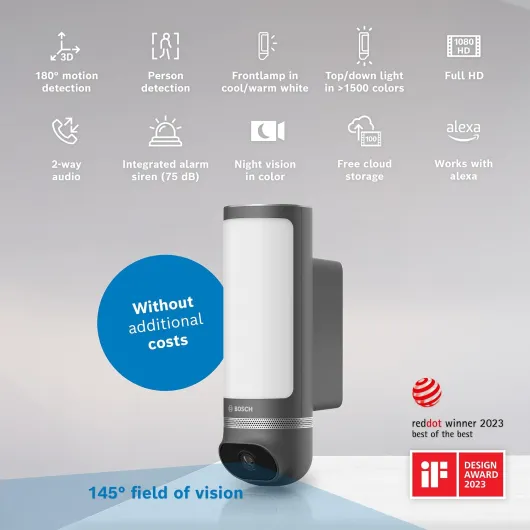
Visually, this is one of the reasons I picked it. The anthracite finish and the overall shape look more like a modern wall light than a classic CCTV dome. Once mounted, it doesn’t scream “security camera” from far away, which I like. It blends in with the facade better than the usual white plastic blocks from other brands. Bosch went for a clean, simple design rather than lots of visible antennas or bulky mounts, and for a house entrance or a garage it fits in well.
The form factor is basically a vertical block with the light and camera integrated, and a dome-style camera lens on the underside. The camera head is adjustable: you can rotate it and tilt it up or down after mounting, which is super handy. I didn’t have to be ultra precise when drilling the holes; I just mounted it roughly where I wanted, then fine-tuned the camera angle. One of the reviewers mentioned this and I had the same feeling: adjustment is straightforward and you don’t need three hands to do it.
From a practical point of view, the design has pros and cons. The integrated light means you only have one device on the wall, so it looks less cluttered. But it also means if you hate the light or angle, you’re stuck with this combination. There’s no separate floodlight you can aim differently from the camera. For most entrances that’s fine, but if you wanted to light up a bigger yard while focusing the camera on a door, you’re a bit limited.
In terms of size, it’s not tiny but not huge either: about 22.4 cm high and 9.9 cm wide and deep, so it has presence but doesn’t dominate the wall. The anthracite color hides dirt and dust pretty well, which is practical outdoors. Overall, I’d say the design is one of the strong points: it looks modern, feels more premium than many plastic competitors, and if you care about how your house front looks, this is a good compromise between security and something that doesn’t look like a factory gate.
Build quality and weather resistance: solid but not bulletproof
The camera housing is mainly metal, which you feel right away when you take it out of the box. It doesn’t feel like thin toy plastic; it has some weight (around 0.9 kg) and feels rigid. For an outdoor device, that’s reassuring. The finish on the anthracite version looks decent and doesn’t scratch easily with normal handling. It’s not luxury-level, but for a garden or driveway, it’s more than acceptable. Compared to cheaper generic cameras, it clearly feels more solid in the hand.
The IP55 rating means it’s protected against dust and jets of water from any direction, but it’s not something you’d fully submerge or blast with a high-pressure cleaner. For a wall-mounted outdoor camera, that’s pretty standard: rain, wind, and temperature changes shouldn’t be a big deal. I’ve had it in place through a few heavy showers and there were no leaks, fogging in the lens, or weird condensation inside. The joints and seals seem correctly done. Time will tell over a couple of winters, but so far, nothing alarming.
One thing to keep in mind: because it’s mains-powered (25 W at 230 V), you need a proper, safe installation. The mounting plate and screws feel okay, not cheap, and once it’s on the wall it doesn’t wobble. But you do need to be comfortable working with electrical cables or get someone who is. There’s no quick magnetic mount or battery compartment; this is more like installing a real outdoor light than plugging in a small camera.
Overall, I’d say the materials and build are one of the good points of the product. It feels like it can handle years of outdoor use if your Wi‑Fi and software issues don’t drive you crazy before that. It’s not military-grade, but for a home setup it’s clearly a step above the ultra-budget plastic cameras that turn yellow and crack after one summer in the sun.
Durability and long-term use: hardware seems fine, software is the question mark
From a physical durability standpoint, the camera gives a good impression. The metal housing, the weight, and the IP55 rating all point to a product that should handle years of rain and temperature changes if installed correctly. The mounting feels secure, and once it’s on the wall, there’s no play or rattling. I don’t see it falling apart anytime soon unless it takes a direct hit from something or is badly installed. The finish doesn’t look like it will fade instantly, and anthracite tends to age better visually than bright white plastic.
Where I have more doubts is the long-term reliability of the Wi‑Fi and the software side. Some users mentioned that the camera disconnects and loses Wi‑Fi completely after power cuts, requiring a painful reinstallation. I haven’t had a big power cut yet, but I did simulate a couple of reboots and noticed that it doesn’t always reconnect as quickly or as cleanly as I’d like. For a security device, that’s not great. You want something you can forget about, not something you have to babysit after every network glitch.
Another point about durability is how dependent it is on Bosch’s app and ecosystem. If the app becomes buggy after an update or if Bosch changes something in their backend, the camera can suddenly feel outdated even if the hardware is still fine. One user mentioned the cameras in the Bosch system feel a bit slow. I agree: the app is not the fastest, and if Bosch doesn’t keep optimizing it, the experience could degrade over time, especially as phones and OS versions move on.
So my feeling is: the hardware will probably outlast the software. The camera itself and the light should keep working physically for years. But the long-term experience will depend on Bosch continuing to support and update the app and keeping the connectivity stable. If they do that, durability is solid. If they don’t, you may end up with a well-built device that becomes annoying to use. That’s something to keep in mind before investing in this kind of connected product.
Performance: good image, decent detection, but a bit slow and picky with Wi‑Fi
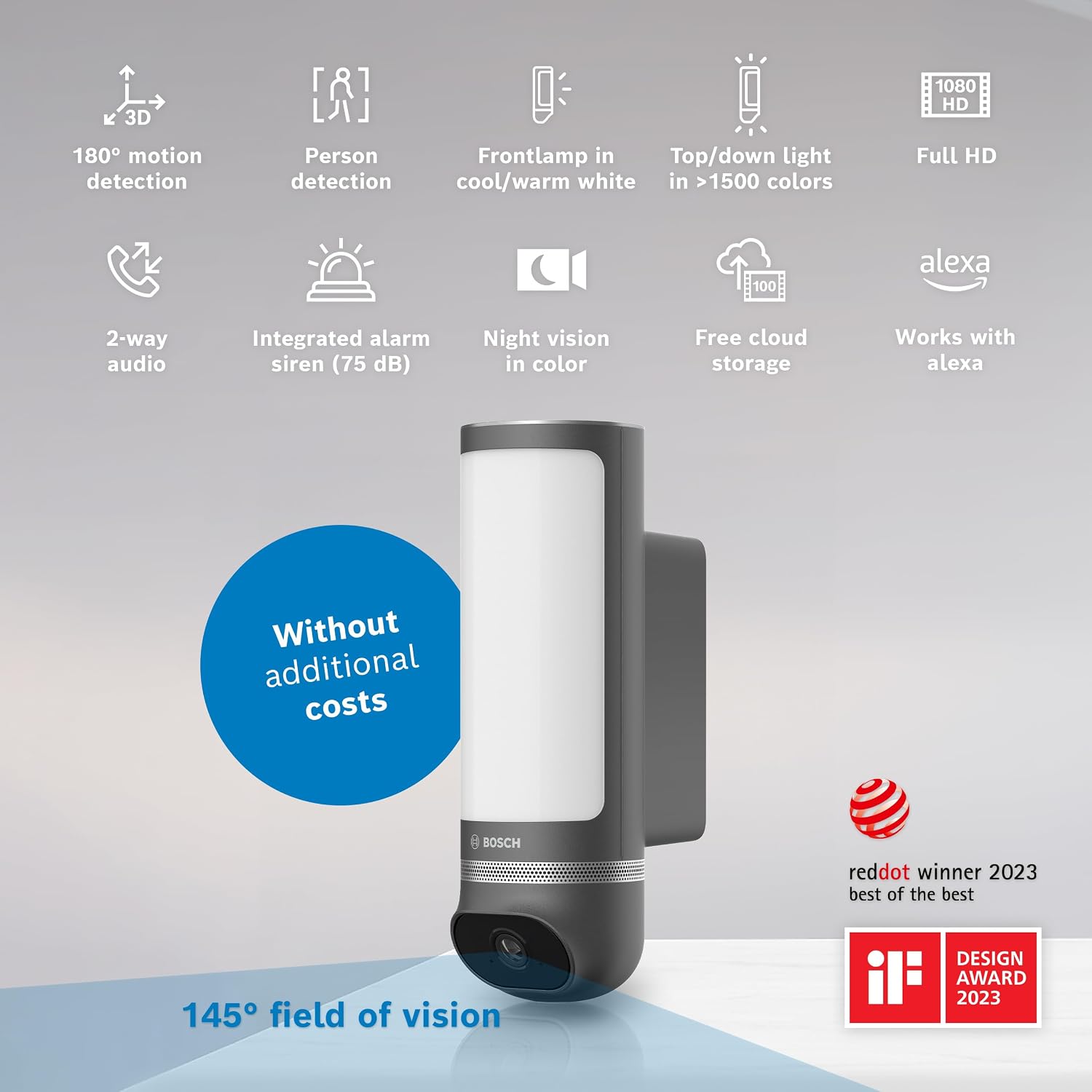
On the performance side, I’ll split it into a few points: image quality, motion detection, night use, and connectivity. During the day, the 1080p image is clear enough to recognize faces, read license plates at short range, and see what’s going on in a front yard or driveway. It’s not ultra sharp like some 4K cameras, but for a 2 MP sensor it does the job. The 145° field of view is wide without being extreme, so there isn’t too much distortion at the edges. For typical home use, it’s fine.
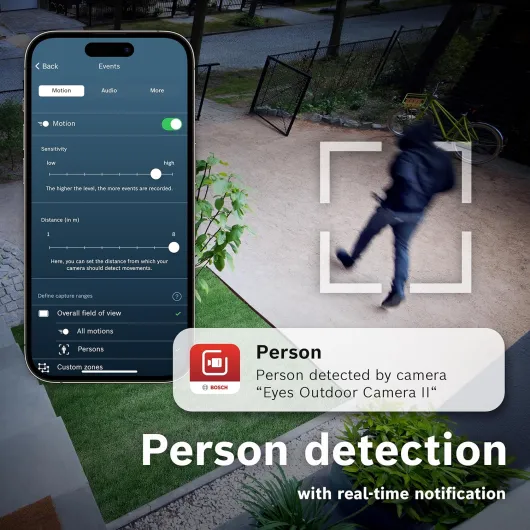
Motion detection is based on video analysis and 3D motion detection, which means the camera tries to detect humans specifically and ignore some random movements. In reality, it reduces false alerts a bit, but it’s not magic. You still have to tune the motion zones and sensitivity. Once set up, it picks up people reliably most of the time and sends push notifications quickly enough, though not instantly. Sometimes there’s a small delay, and occasionally it triggers a bit late, catching someone mid-way through the frame rather than at the moment they appear.
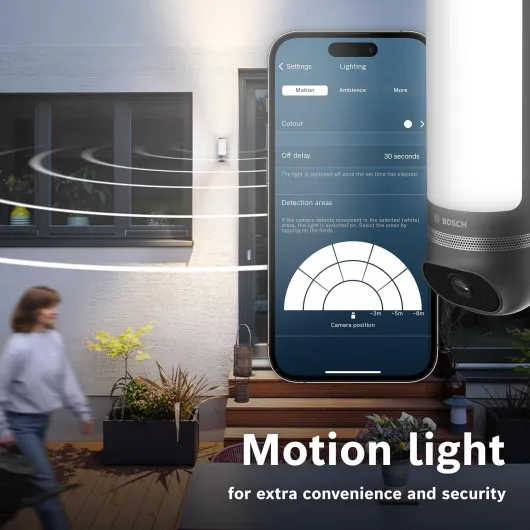
At night, there’s no classic infrared black-and-white mode. Instead, the integrated light turns on when motion is detected, so the camera records in color. When this works well, the result is nice: you get color footage of people approaching your door. The issue is that the light sometimes activates with a slight delay, like one of the Amazon users mentioned. So you can end up with the first second or two in darker conditions and then it brightens. It’s not terrible, but it’s not perfect either. Also, if you want discreet monitoring at night without a visible light, this product isn’t ideal because the whole concept is based on that light.
Connectivity is where I had the most frustration. The camera is Wi‑Fi only (no Ethernet), and it strongly prefers a stable 2.4 GHz network. During setup, if your router broadcasts 2.4 and 5 GHz under the same name, it can get confused, recognize the camera, and then fail at registration because it tries to jump to 5 GHz. I had to temporarily disable 5 GHz to get it to register correctly, exactly like another buyer described. Once connected, it’s usually stable, but a power cut or Wi‑Fi hiccup can sometimes make it drop off and you might have to fiddle with it again. That’s where the negative reviews about disconnections start to make sense. Overall, performance is decent, but not as smooth and reliable as I’d like for something that’s supposed to watch over the house 24/7.
What this camera actually offers in real life
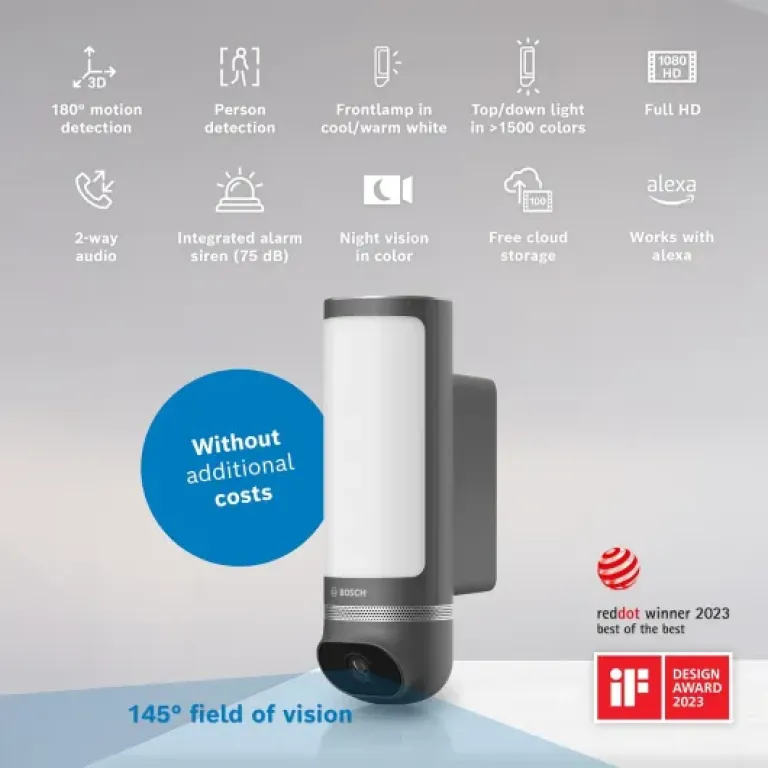
On paper, the Bosch Smart Home Outdoor Camera II is pretty complete: 1080p Full HD video, 145° field of view, integrated outdoor light (up to 1100 lumens), alarm siren (around 75 dB), Wi‑Fi connectivity, IP55 weather rating, and compatibility with Amazon Alexa and the Bosch Smart Home system. It can also be used standalone with the Bosch Smart Home Camera app, which is what many people will do at first. That’s the theory.
In practice, the main thing is that it replaces your existing outdoor light. It runs on 230 V AC (no battery), so you connect it to your old wall light cables. Once it’s powered, you pair it with your Wi‑Fi. Important detail: during setup it really prefers 2.4 GHz only. If your router uses the same network name (SSID) for 2.4 and 5 GHz, you might have to temporarily disable 5 GHz, otherwise the registration can fail or loop. I had to play with my router settings like one of the Amazon reviewers described, which is annoying for a product in this price range.
The camera records in MP4, 2 MP resolution, and uses video analysis plus 3D motion detection to spot humans in defined zones and send notifications. That sounds fancy, but in daily use it mainly means you can set areas where motion should trigger alerts and recording. It works decently once you’ve tuned the zones and sensitivity, but it’s not perfect. Sometimes it reacts a bit late, sometimes it catches someone just as they’re leaving the frame.
Overall, as a package, you get a light, a camera, a siren, and app control. It’s pretty solid if you want one device instead of three. But you have to accept that it’s not the fastest system in the world and that the initial network configuration might cost you some time. If you’re okay with that and you like Bosch’s ecosystem, it’s a coherent product. If you want plug-and-play simplicity, there are easier options out there.
Does it actually improve security?
In terms of real security, the camera does help, but you have to be realistic about what it can do. The combination of camera + light + siren is quite handy. When someone approaches at night, the light comes on, which already acts as a deterrent for casual trespassers. If you see something suspicious in the app, you can trigger the siren (around 75 dB) and a flashing red light with one tap. It’s not as loud as a full alarm system siren, but it’s enough to scare off someone hanging around your entrance or driveway.
What I liked is the two-way audio. If someone is at the door, you can talk to them through the app thanks to the built-in microphone and speaker. For deliveries or to tell someone you see them, it’s practical. The latency is acceptable, not perfect, but usable. Combined with live video streaming, you basically get an intercom plus security camera in one. For me, this replaced a separate cheap doorbell camera that was less reliable.
Motion notifications are useful, but you need to tune them, otherwise your phone will go crazy with alerts every time a cat passes or a branch moves. With the Bosch app, you can define motion zones and adjust sensitivity, which helps a lot. Once I fine-tuned it, I mostly got alerts for actual people. In a Bosch Smart Home system, you can also link it to other devices, like having lights inside turn on when motion is detected, which strengthens the deterrent effect.
On the downside, the slight delays in motion activation and the occasional Wi‑Fi drops reduce the overall effectiveness a bit. If the camera is offline right when something happens, or the light kicks in late, the system obviously loses its point. Also, there is no 24/7 local recording on a built-in SD card mentioned here; everything goes through the Bosch ecosystem and app, which means you’re dependent on their servers and software. So yes, it improves security compared to having nothing or just a dumb light, but it’s not foolproof and it’s not the most robust solution I’ve ever seen.
Pros
- Solid metal build and modern anthracite design that looks like a normal wall light
- Useful combo of camera, strong light (up to 1100 lumens), and siren in one device
- Good daytime image quality and practical two-way audio for talking to visitors
Cons
- Wi‑Fi setup and reconnection can be fussy, especially with mixed 2.4/5 GHz networks
- App and camera responsiveness are a bit slow, with occasional delays in motion/light activation
- Price is high compared to competitors offering smoother software and similar features
Conclusion
Editor's rating
After using the Bosch Smart Home Outdoor Camera II for a while, I’d sum it up like this: it’s a well-built, good-looking outdoor light-camera combo that does its job, but it’s held back by a few software and Wi‑Fi quirks. The image quality is fine for 1080p, the integrated light is strong and practical, and the siren plus two-way audio give you real tools to react if someone is hanging around your entrance. As a physical object, it inspires more confidence than many plastic competitors.
Where it falls short is mainly on ease of use and long-term reliability of the connection. The setup can be fussy if your router uses 2.4 and 5 GHz under the same name, and some users (and my own tests) show that power cuts and network glitches can lead to annoying reconnections or even full reinstallation. The app is usable but not very snappy, and motion/light response at night can be slightly delayed. None of this makes the product useless, but it does lower the overall feeling compared to what you’d expect at this price.
I’d recommend this camera mainly to people who already have Bosch Smart Home gear or really care about having a camera that looks like a neat wall light rather than a security gadget. If you want the smoothest app experience, the most reactive motion detection, or maximum flexibility for recording and integrations, there are better choices in the same price range. For me, it’s a decent but imperfect product: it gets the job done, but you need a bit of patience and you should go in knowing its limitations.