
Summary
Editor's rating
Is it good value for money, considering there’s no hard drive?
Design and build: light but not flimsy
Build quality, weather resistance, and how confident it feels long term
Image quality, WiFi stability, and how it behaves day to day
What you actually get in the box (and what you don’t)
Human detection, alerts, and how useful it actually is in real life
Pros
- Clear 5MP image quality with good detail at typical home distances
- Stable wireless link between cameras and NVR, no video cables needed
- 10‑channel NVR gives room to add more cameras later
- Human detection and intuitive playback timeline make searching footage easier
Cons
- No hard drive included, so you must buy or reuse one to actually record
- Cameras feel a bit light and not as robust as higher‑end systems
- AI detection and app are decent but not on the same level as more expensive brands

Specifications
View full product page →| Brand | SANNCE |
A straight-talking CCTV kit for people who just want it to work
I set up this SANNCE 5MP wireless CCTV kit at home to replace an older 1080p wired system that was starting to glitch. I’ve had it running for a bit now, enough to see the good, the annoying, and the stuff you only notice once you live with it day to day. I’m not an installer, just a reasonably handy person who’s mounted a few cameras before and hates wasting weekends on clunky tech.
The first thing that stood out is that this is a proper NVR kit, not just a bunch of random WiFi cameras tied to an app. You get a 10‑channel NVR, 4 cameras, power supplies, mouse, and antennas. What you don’t get is a hard drive, so you either have to reuse one from an old system or budget extra for that. That’s important because without a drive, you basically have a live-view system and not much else.
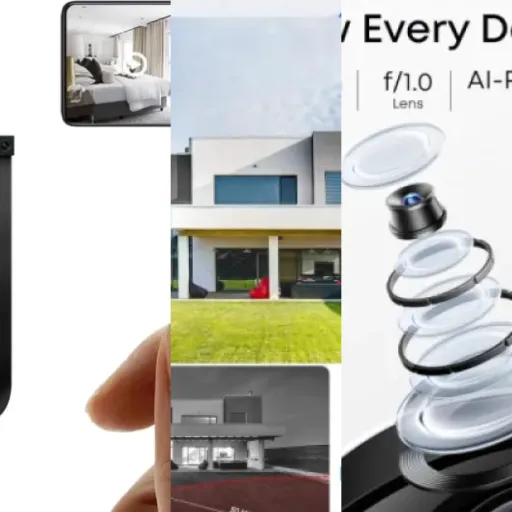
My goal with this setup was simple: see who’s at the front door, watch the driveway and garden, and be able to scrub through recordings quickly when something happens. In practice, this kit actually does that fairly well. The 5MP image is clearly sharper than 1080p, especially when you zoom in a bit on faces or number plates at short range. It’s not magic, but it’s a noticeable step up from budget Full HD cameras.
Is it perfect? No. There are small annoyances around the app, the missing HDD, and the fact the cameras feel a bit light in the hand. But overall, as a basic home/driveway system with room to add more cameras later, it’s pretty solid and surprisingly hassle‑free once you’ve done the initial setup. If you’re expecting pro‑grade build or ultra‑smart AI, you’ll be a bit underwhelmed. If you just want something that works and don’t mind a bit of DIY, this is a decent option.
Is it good value for money, considering there’s no hard drive?
Value wise, this kit sits in that middle ground: not bargain‑basement, not premium. You’re paying for 4 x 5MP WiFi cameras, a 10‑channel NVR, and the convenience of a mostly plug‑and‑play setup. The catch is the missing hard drive. By the time you add a decent 1–2TB HDD, the total cost creeps up. If you already have a spare drive from an old system, then the value immediately looks better.
Compared to cheap standalone WiFi cameras that just record to microSD or cloud, this setup gives you a proper centralised recorder, better control over playback, and more reliable local storage. For someone who wants a proper CCTV system rather than a random mix of cameras and apps, the price is easier to justify. On the flip side, if you only need one or two cameras and don’t care about an NVR, you might find cheaper options that do the job well enough.
The 10‑channel capacity is a plus for value. You start with 4 cameras but have room to expand later without replacing the NVR. That spreads the cost over time. The included separate PSUs, decent night vision, and human detection all add up to something that feels fair for what you pay. It’s not a steal, but it doesn’t feel like you’re being ripped off either.
So in simple terms: good value if you actually use what it offers – multiple cameras, NVR, local storage, and app access. If you just want one camera to see who’s at the door, it’s overkill and you’re better off with a single smart cam. If you’re looking to cover a house or small business with a system you can expand, this SANNCE kit lands in a sensible price/performance spot, as long as you remember to budget for that hard drive.
Design and build: light but not flimsy
Design‑wise, everything is pretty simple and functional. The NVR is a small black box that disappears nicely next to a TV or router. No LEDs screaming in your face, no big logo, no buttons. You just plug in the mouse and do everything on screen. I actually liked that minimal approach – it looks like generic AV gear, not some flashy security box. For a living room or hallway setup, that’s a plus.
The cameras are the usual bullet style in white, with a metal body and plastic bits around the front. In the hand they feel lighter than I expected, which at first worried me a bit. But once mounted on the wall, they feel solid enough. They’re not chunky like some pro PoE cameras, but they don’t feel like cheap plastic toys either. The brackets allow for decent adjustment, though like most bullet cams, you’ll want to take a minute to get the angle right before tightening everything properly.
Port layout on the NVR is logical: HDMI and VGA on the back, LAN, USB, and the antenna connector. You can tell the system is meant to be operated with a mouse and a monitor, not just via app. That’s good when you’re doing more advanced stuff like searching long recordings or tweaking detection zones. The menus are basic looking, but the layout is intuitive enough that you don’t get lost once you’ve clicked around for a few minutes.
Overall, the design is nothing fancy, but practical. It doesn’t try to be stylish, and that’s fine. My only real nitpick is the cameras could feel a bit more substantial, just to give more confidence when you’re installing them in harder‑to‑reach spots. That said, given the IP66 rating and metal shells, they’re clearly built to live outside. For a home setup, the design is perfectly acceptable and doesn’t draw too much attention, which is what I want from security gear.
Build quality, weather resistance, and how confident it feels long term
On paper, the cameras are IP66 waterproof and rated to work from -20°C to 60°C. I obviously haven’t tested the full temperature range, but they’ve handled typical rainy, windy weather without any issues so far. The metal housings give some confidence, and as long as you mount them under a small overhang or at least not pointing straight up into the sky, they should cope fine with normal outdoor use.
The fact that each camera has its own power supply is a good sign from a reliability point of view. A lot of cheaper kits run everything off one big brick, and when that goes, the whole system dies. Here, if a PSU fails, it’s just one camera. Also, separating power for the NVR and cameras reduces stress on the NVR, which should help it last longer. The NVR itself is light but doesn’t feel fragile. It’s not a tank, but it’s not something you’ll be throwing around either – it just sits on a shelf and does its job.
One thing to keep in mind is cable management and mounting. The camera tails (where the power connector is) need a bit of protection. If you just leave the connectors hanging out in the open, water can get in over time and cause problems. I routed the cables through the wall where possible and used junction boxes or silicone around the entry points to keep things dry. That’s not unique to this kit – it’s just how outdoor cameras are in general – but worth mentioning if you’re new to this.
Overall, I’d call the durability pretty solid for home use. It doesn’t feel like industrial‑grade kit for building sites, but for a house, small shop, or garage, it seems more than adequate. If you install it properly and don’t abuse the cables, I don’t see any obvious weak point that would fail quickly. The only minor worry is the relatively light feel of the cameras, but given the metal shells and weather rating, that’s more about perception than actual performance so far.
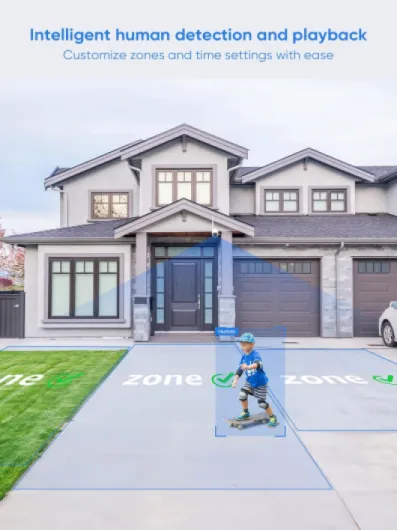
Image quality, WiFi stability, and how it behaves day to day
On the image quality side, the 5MP resolution is a clear step up from older 1080p kits I’ve used. You’re looking at roughly 2560 x 1920, so when you zoom in on a recording, faces and details hold up better than Full HD. At around 5–8 metres you can usually recognise a face quite easily, and for slow or parked cars you can read number plates if the angle and lighting are reasonable. For fast‑moving cars, especially at night, plates can still blur – that’s normal at this price point and with this frame rate.
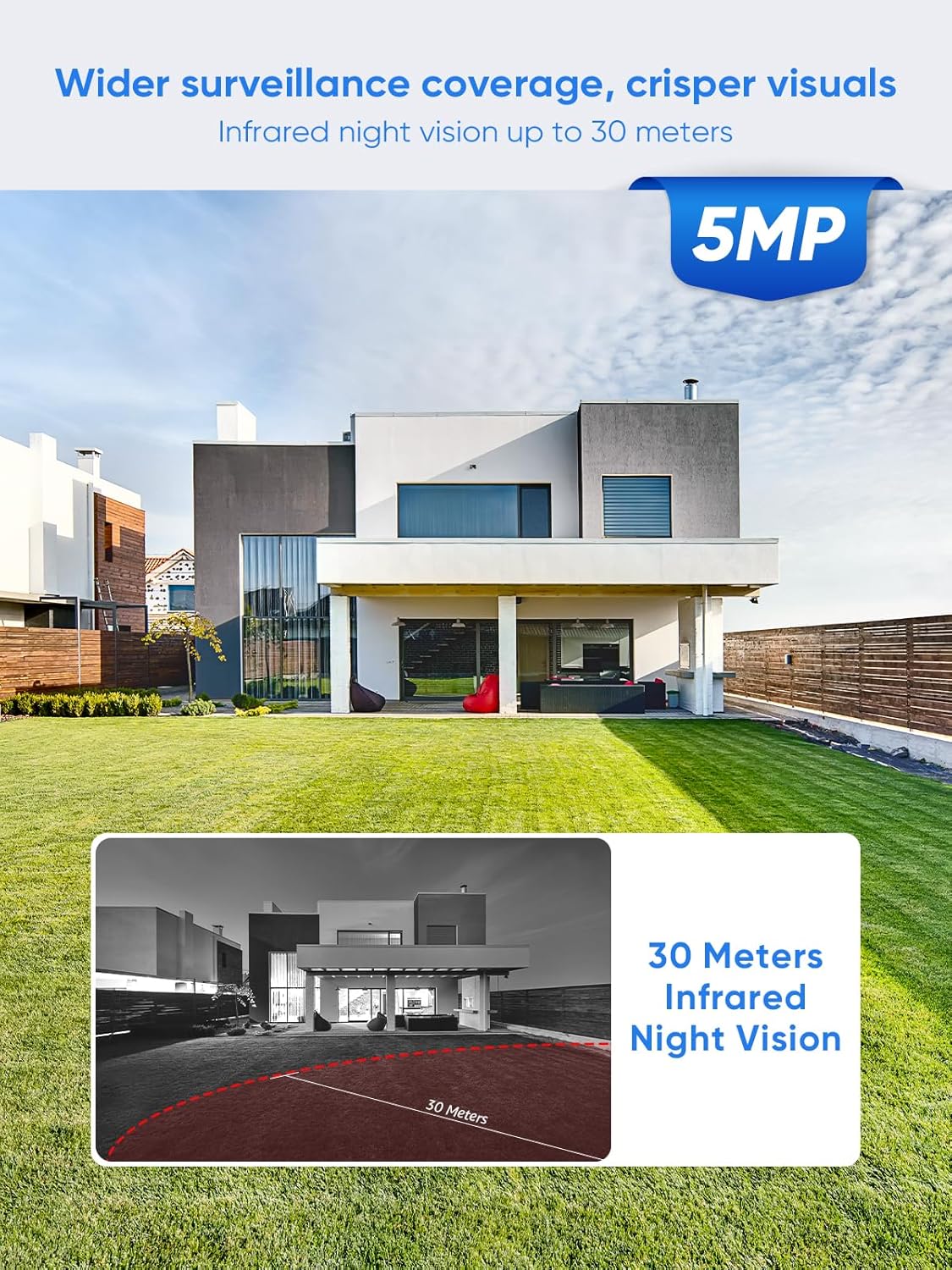
Night vision is decent but not magical. Up to about 10 metres, things are quite clear: you can see faces, clothing, and what someone is doing. Between 10 and 20 metres, you still see people and can recognise them if you know them, but fine details start to fade. Beyond that, it’s more about seeing movement and shapes than clear identification. For a driveway, front door, or small garden, it’s fine. If you’re trying to cover a huge yard with a single camera, you’ll be stretching it.
The WiFi connection has been surprisingly reliable. I didn’t get dropouts on the cameras I installed, even through a couple of walls. The point‑to‑point wireless with their private protocol seems to do its job. You still need power cables to every camera, which some people forget when they hear “wireless”. In my setup, the cameras were roughly 8–12 metres from the NVR through standard brick walls, and the signal bars stayed high. The system also supports cascading/relay if you want to extend range, but I didn’t need that.
In terms of daily use, the system runs quietly in the background. Once I set it to 24/7 recording on all 4 channels, it just kept going. Playback is one of the stronger points: the timeline is easy to scrub, and motion/human events are marked, so you can jump straight to them. Human detection works reasonably well, cutting out a lot of false alerts from random movement, though it’s not perfect – you’ll still get the odd unnecessary notification. Overall performance: solid for a home user, not flawless, but reliable enough that I trust it to capture what I need.
What you actually get in the box (and what you don’t)
Out of the box, the SANNCE kit is pretty straightforward. You get: a 10‑channel NVR, 4 x 5MP WiFi cameras, power adapters for each camera, the NVR power adapter, a USB mouse, antennas, and some basic mounting hardware. No HDMI cable included on my end, so keep that in mind if you plan to hook it up to a TV or monitor straight away. And again, no hard drive included, which is the big missing piece here. The NVR supports up to 10TB, but you have to bring your own disk.
The NVR itself is compact and light, with a matte black finish and no buttons on the front. Everything is done with the mouse and the on‑screen menus. It has HDMI and VGA outputs, a LAN port, USB ports, and the antenna connector. You can hook it to your router by Ethernet or WiFi, but honestly, wired is more stable and I stuck with that. The cameras come in separate small boxes, each with its own PSU and antenna, which is nice because you’re not fighting over one big power brick.
In terms of features on paper, you get 5MP resolution, night vision up to about 30m, human detection, app alerts, two‑way audio, IP66 weather rating, and Alexa support. The NVR handles up to 10 channels, so you can add 6 more cameras later if you want. Recording can be motion‑based or continuous, and the encoding is H.264+, which just means you save a bit of space on the hard drive compared to older codecs.
From a practical point of view, this is a mid‑range home kit. It’s not a cheap toy, but it also doesn’t feel like the high‑end stuff installers use on big sites. The focus is clearly on being plug‑and‑play over WiFi, making it less of a headache for someone who doesn’t want to run video cables everywhere. If you’re expecting full PoE, super heavy cameras, and advanced analytics, this isn’t that. If you want something that covers the basics properly with some extra features like human detection and app access, the spec sheet matches that goal.

Human detection, alerts, and how useful it actually is in real life
This is where you see if the system is just specs on a box or actually useful. The human detection feature is one of the main selling points, and in practice, it’s fairly helpful. You can set specific monitoring areas and time schedules, so for example you only get alerts for the driveway at night, or only for the back garden during certain hours. That cuts down on spam from trees, cars in the distance, or shadows moving around.
In my use, the person detection picked up people walking up the drive or approaching the door reliably. It did a good job ignoring small movements like leaves and minor light changes. However, like most budget AI, it’s not perfect: sometimes a larger moving object (like a big dog or someone on a bike) still triggers a person event. It’s not a disaster, but don’t expect the same precision you’d see on more expensive systems. The good part is that in playback, human events are highlighted on the timeline, so when something happened overnight, I could quickly jump to the right moments without watching hours of footage.
The app alerts are fairly quick as long as your NVR is properly connected to the internet via LAN or stable WiFi. You get push notifications on your phone and can tap through to see what triggered it. Email alerts with snapshots are also available, which is nice if you want a backup record in your inbox. I didn’t bother leaving every alert on all day because that gets old fast, but for night and away‑from‑home times, it’s useful.
So in real life, does it help you catch what matters? Yes, it does. You can see who came to the door, when packages were dropped, when the kids got home, and if anyone was snooping around. It’s effective enough for normal home security, but you have to spend a bit of time setting the zones and schedules properly. If you just leave everything on default, you might get more alerts than you’d like. Once dialled in, it’s a good balance between being informed and not being spammed every time a car drives by.
Pros
- Clear 5MP image quality with good detail at typical home distances
- Stable wireless link between cameras and NVR, no video cables needed
- 10‑channel NVR gives room to add more cameras later
- Human detection and intuitive playback timeline make searching footage easier
Cons
- No hard drive included, so you must buy or reuse one to actually record
- Cameras feel a bit light and not as robust as higher‑end systems
- AI detection and app are decent but not on the same level as more expensive brands
Conclusion
Editor's rating
Overall, this SANNCE 5MP wireless CCTV kit is a solid, no‑nonsense option if you want a proper NVR‑based system at home without messing around with long video cables. The 5MP image is clearly sharper than older 1080p kits, night vision is good enough for normal driveways and gardens, and the WiFi link between cameras and NVR is stable. Human detection and the way events are marked on the playback timeline make it practical when you actually need to find something that happened overnight or while you were away.
It’s not perfect. The cameras feel a bit light, there’s no hard drive included, and the AI detection isn’t magic – you’ll still get the odd false alert. The app is functional rather than slick, and you need to spend a bit of time setting up zones and schedules if you don’t want notification overload. But once it’s dialled in, it just quietly does its job, which is really what you want from a security system.
If you’re a homeowner or small business owner who wants a straightforward, expandable system with local recording and decent image quality, this kit makes sense, especially if you already have a spare HDD lying around. If you only want one camera, hate any kind of DIY, or expect high‑end analytics and super polished software, you should probably look elsewhere. For most regular users who just want to see what’s going on around their property and be able to check recordings easily, this SANNCE system is a pretty solid, practical choice.