
Summary
Editor's rating
Price, storage options, and if it’s worth your money
Bulky but practical design with real coverage
Build quality, weather resistance, and long-term concerns
Image quality, motion detection, and night use in real life
What you actually get and how it works day to day
Does it actually improve security and catch what matters?
Pros
- Strong 2600 lumen floodlights with adjustable brightness and duration
- 3K resolution with wide 166° view and 360° PTZ for broad coverage
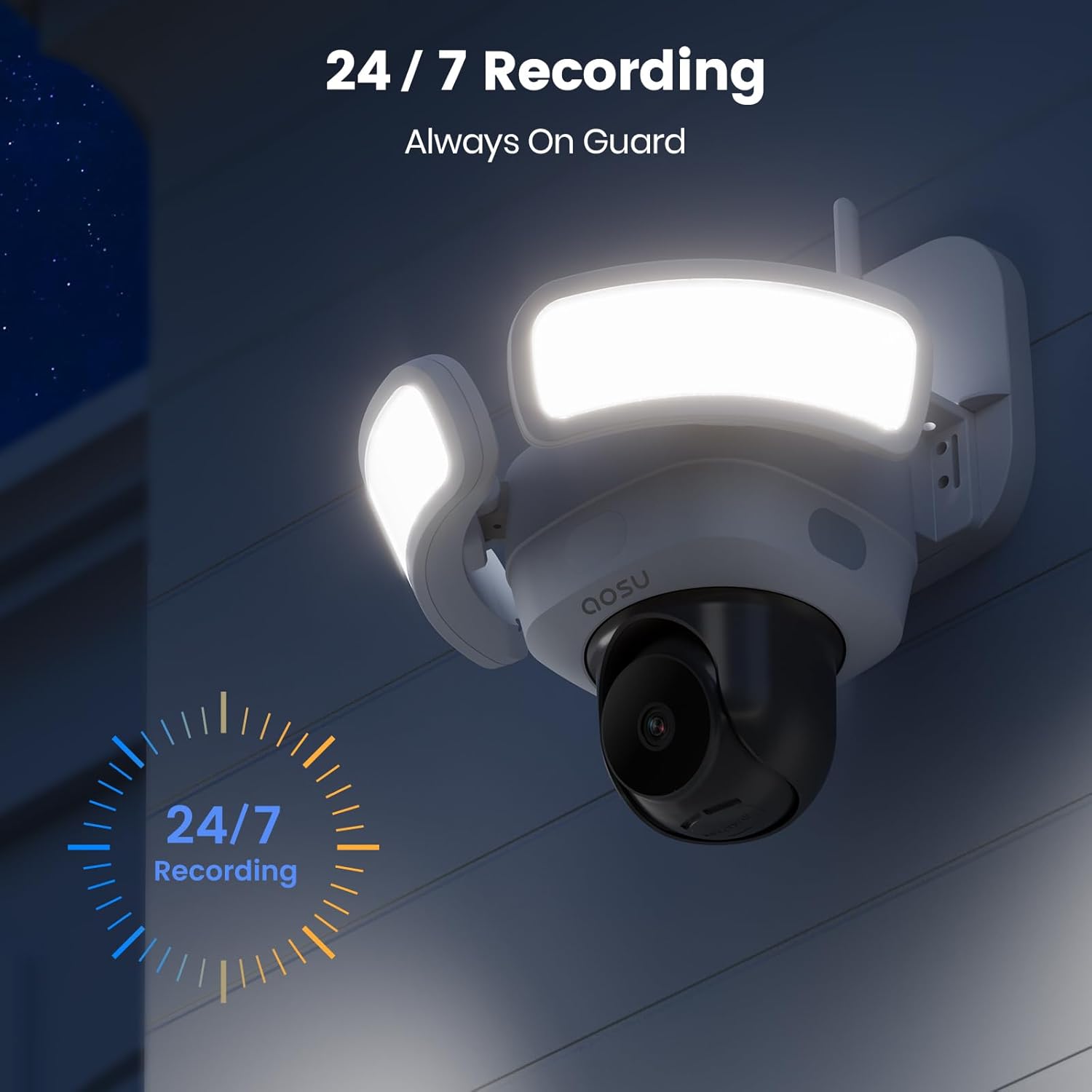
- 24/7 local recording to microSD without mandatory subscription
Cons
- Bulky plastic design and fairly visible on the wall
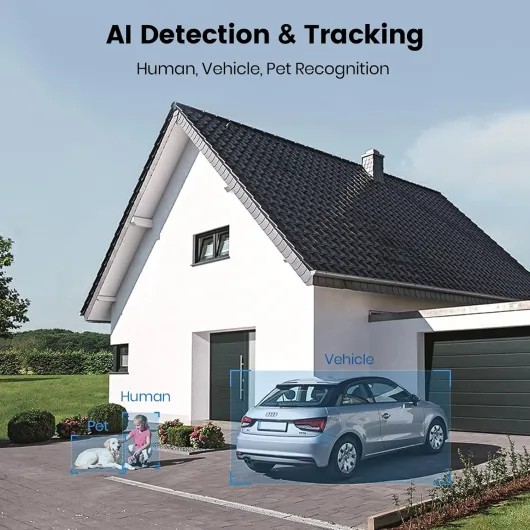
- Advanced AI detection (people/cars/pets) requires paid aosuProtect+
- Requires mains wiring, so not ideal for renters or DIY‑shy users

Specifications
View full product page →| Brand | aosu |
Hard-wired camera that actually covers the whole driveway
I installed this aosu floodlight camera above my garage about three weeks ago, replacing an older dumb floodlight and a separate 1080p camera. So I went from two devices to one. I wired it into the existing light circuit and connected it to my 2.4 GHz Wi‑Fi. Since then, it’s been running 24/7, recording continuously to a microSD card and sending motion alerts to my phone.
Right away, the big difference for me was the combo of the 360° pan/tilt and the 270° motion detection. My old fixed camera always missed people who came in from the side path. With this one, the side PIR sensors pick up movement and the camera actually turns to follow. It’s not sci‑fi level tracking, but in practice it means I finally see people walking up from the side gate, not just the middle of the driveway.
I’ve mainly used it for three things: checking packages, keeping an eye on cars parked in front, and seeing what’s going on when the dog randomly barks at night. The 3K image is clearly sharper than the 1080p I had before, especially when I zoom in to see faces or plates at close range. At night, with the floodlights on, the picture is basically like daytime within that 8–10 m zone.
It’s not perfect though. The app is decent but not super polished, the AI options are partly paywalled behind aosuProtect+, and the camera movement can be a bit slow if you’re manually steering it. But overall, as a hard‑wired outdoor floodlight cam that just records all the time and doesn’t force a subscription, it’s pretty solid so far.
Price, storage options, and if it’s worth your money
In terms of value for money, this aosu floodlight cam sits in that mid-range spot. It’s not as cheap as basic 1080p floodlight cams, but it’s also clearly cheaper than some bigger-name brands that push you into mandatory cloud subscriptions. What you’re paying for here is the combo of 3K resolution, strong 2600 lumen floodlights, PTZ coverage, and 24/7 recording without being forced into a monthly fee.
The local storage with a microSD card is a big plus for me. I stuck in a 128 GB card, and with HEVC recording 24/7, I can scrub back a few days easily. If you want longer history, you can go up to 512 GB (assuming the higher spec is correct). No subscription needed for that. The cloud option is there if you want offsite backup or easier remote access, but it’s optional. That’s better than a lot of competitors that lock key features behind a paywall.
Where they do try to nudge you is with the aosuProtect+ AI features. Basic motion detection and zones are free, but smarter detection for people, cars, and pets is paywalled after the trial. Compared to competitors, that’s pretty standard now, so I’m not shocked, but it’s something to factor in. If your area is calm and you don’t get tons of false alerts, you can probably skip the subscription and just rely on the PIR + zones.
Overall, I’d say the value is good but not unbeatable. If you just need a simple cam, this might feel like overkill. But if you were already thinking of buying a separate floodlight plus a decent camera, this 2‑in‑1 is a sensible option. You get strong lighting, wide coverage, and no forced monthly bill. For someone who wants a solid, wired, set‑and‑forget outdoor cam for a driveway or garden, the price feels fair for what it delivers.
Bulky but practical design with real coverage
Physically, this thing is not small. It’s about 24 x 23 x 23 cm and weighs around 2 kg, so once it’s on the wall it’s quite visible. If you’re looking for something discreet, this is not it. On the flip side, as a deterrent, the size helps – it clearly looks like a security device, not just a cute little camera. The two floodlight panels sit on each side of the central camera dome, and you can adjust their angle manually to point more towards the driveway or the garden.
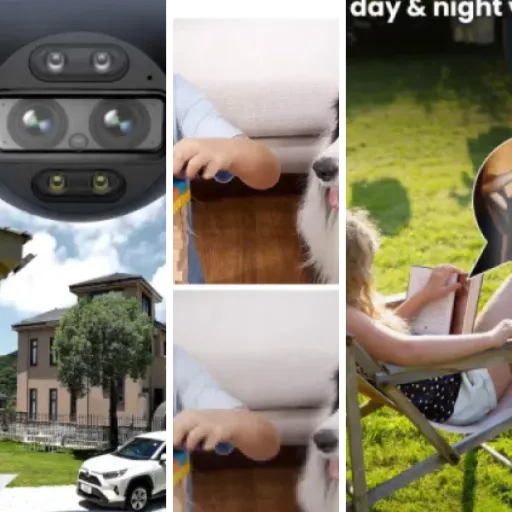
The main camera is in a dome-style housing that can pan and tilt to give you that 360° coverage. In practice, it doesn’t spin endlessly in a circle like a pro PTZ dome; it rotates enough to cover all the usual angles on a wall mount. When I mounted it on the corner of my garage, I could cover both the driveway and a good chunk of the side path, which I couldn’t do with a fixed cam. The field of view is 166°, so even without moving, it already sees quite wide; the pan just adds more flexibility.
I like that the antennas are external. They’re not pretty, but they help Wi‑Fi stability. I’d rather have slightly ugly antennas than a camera that keeps dropping off the network. There’s also a visible status LED; not a big deal, but it helps during setup to know if it’s actually connected or not. The whole unit is IP65, so it should be fine in rain and dust. Mine has already gone through a few heavy rain days and a windy night and it didn’t budge or leak.
Design-wise, my only real complaint is the bulk and the all‑plastic build. It feels solid enough, but it doesn’t give that rugged metal vibe some higher-end brands have. Also, the dome can collect a bit of dust and water spots, so you’ll want to wipe it every now and then if you care about image clarity. Overall though, it’s a functional, no-nonsense design that focuses more on coverage and brightness than on looking sleek.
Build quality, weather resistance, and long-term concerns
It’s still early days for me, but I can at least talk about build and weather handling so far. The camera is rated IP65, which means it’s protected against dust and low-pressure water jets. In normal language: it’s fine for outdoor rain. Mine is mounted in a fairly exposed spot above the garage, with no big overhang. We’ve had a couple of heavy rain showers and some strong wind since I installed it, and I haven’t seen any water inside the dome or flickering in the lights.
The housing is plastic, which is pretty common at this price point. It doesn’t feel cheap, but it also doesn’t have that heavy-duty metal feel you get on more expensive pro gear. I don’t think that’s a dealbreaker, but if you’re in a very harsh climate (coastal salt air, extreme sun), I’d keep an eye on it over time. The joints for the floodlight arms and the dome movement feel reasonably tight and don’t wobble when the wind hits.
Thermally, the unit gets just a bit warm when the floodlights have been on for a while, but nothing alarming. The LEDs are 24 W total, so it’s not like a huge halogen floodlight that cooks everything around it. The camera and Wi‑Fi connection have stayed stable even during a colder night (around 3–4°C). I haven’t tested it in heavy snow or extreme heat yet, so that’s still an open question, but for average European/UK style weather, it seems fine so far.
Long-term durability is always a bit of a gamble with smart cameras. The moving parts (PTZ) are the main concern because motors can wear out. I haven’t seen any grinding or weird noises yet; the movement is smooth and consistent. If you’re worried about that, you can set fewer patrols and avoid constant back-and-forth scanning. With a 1-year manufacturer warranty, you’re covered for early failures but not for multi-year issues. I’d say it feels solid enough for several years of normal use, but I wouldn’t expect it to last like a high-end commercial-grade PTZ costing three times more.
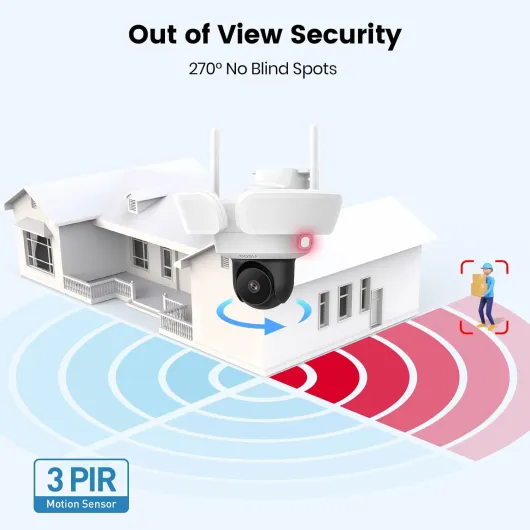
Image quality, motion detection, and night use in real life
On the performance side, the 3K (1620p) resolution is a clear step up from older 1080p cams I’ve used. At normal viewing distance on a phone, everything looks sharp, and when you pinch to zoom on a face or a license plate within about 6–7 meters, you still get useful detail. It’s a 5 MP sensor with 20 fps, so motion looks smooth enough for security use, not cinematic but good. The HEVC/H.264 encoding keeps file sizes reasonable; my 128 GB card holds several days of continuous recording without issues.
The 270° motion detection using three PIR sensors is probably the main strong point. I tested walking from different sides: straight in front, from the left side path, and from the right near the fence. It picked me up every time within about 8–10 meters. What’s nice is that even if I start outside the camera’s initial viewing area, the sensor triggers and the cam rotates to follow. There’s a tiny delay before it fully turns, but for security footage, it’s fine – you still see the person as they come into the main zone.
At night, there are two modes: standard night vision with infrared, and full-color night when the floodlights turn on. With the 2600 lumen LEDs at 6500K (cool white), the area in front of my garage basically looks like daytime inside that 10 m cone. Beyond that, it gets darker but still usable. If you don’t want to blind your neighbors, you can lower the brightness and shorten the on-time. I ended up reducing brightness a bit because the default felt a bit too intense for a narrow street.
In terms of smart detection, the basic motion alerts are fine. When I enabled the trial of aosuProtect+ for people and car detection, notifications became more relevant, but I’m not sure I’d pay long-term unless I had a lot of street traffic. The people detection was mostly accurate; it didn’t trigger on cats or tree shadows, which helped. Overall, performance is pretty solid for the price: good image quality, reliable motion detection, and floodlights that do what they’re supposed to do without drama.
What you actually get and how it works day to day
Out of the box, you get the floodlight cam head, a mounting base/junction box kit, an installation hook and string (handy when you’re on a ladder), screws and anchors, and a USB‑C power cord mainly for setup or bench testing. There’s no microSD card included, so if you actually want local storage you need to buy one separately. The spec says up to 128 GB in one place and 512 GB in another; I used a 128 GB card and that worked fine, but that inconsistency is a bit confusing.
The camera is hard‑wired to 240 V AC, so this is meant to replace an existing outdoor light or be wired like one. No batteries to charge, which I like, but you do need to be comfortable turning off the breaker and doing basic wiring or get someone who is. Once powered, pairing is done via Bluetooth and then it connects to 2.4 GHz Wi‑Fi. On my setup (router about 10 m away through two walls), the signal has been stable with no random offline episodes yet.
In the app, you can set it to 24/7 recording or motion-based, define activity zones, and tweak how the floodlights behave (brightness and how long they stay on). There’s also aosuProtect+ for smarter AI detection (people, cars, pets). The base motion detection using the 3 PIR sensors is already pretty good, so I’d say the extra AI is nice to have but not mandatory unless you’re getting spammed by moving trees or cars in the street.
Day to day, it basically works like this: someone walks into the detection area, the lights come on, the camera wakes up (if it wasn’t already recording), it may rotate to follow, and you get a notification on your phone. You open the app, see a live view, talk through the speaker if you want, and later you can scrub back through the continuous timeline thanks to the microSD card. It does the job of a floodlight plus camera pretty cleanly, without feeling like a science project every time you open the app.
Does it actually improve security and catch what matters?
After a few weeks, the big question for me is: does this camera actually help with security, or is it just another gadget? In my case, it did make a difference compared to my previous setup. The combination of 24/7 recording, strong lighting, and wide coverage means I finally have consistent footage of anyone approaching the house, not just random clips when the old camera decided to wake up.
For deliveries, it’s been handy. The camera catches the delivery driver as they walk up, the floodlight comes on, and I get a notification within a few seconds. If I’m home but in the back of the house, I can quickly check the live view and either go out or just see where they left the package. The two‑way talk works, but the speaker is not super loud; it’s fine if the person is fairly close to the camera, less so if they’re at the gate a bit further away.
In terms of deterrence, the bright floodlights plus visible camera seem to do the job. We had a couple of teens loitering near the driveway one evening; as soon as they stepped into the detection zone, the lights kicked in and they walked off pretty quickly. It’s not scientific proof, but clearly the presence of a big light and camera made them rethink staying there. That’s basically what I want from a device like this: make people aware they’re being watched and recorded.
There are some limits. If your main concern is events happening further than about 10–12 meters away (like across a wide street), this camera isn’t magic – you’ll see shapes, but identification will be harder. Also, while the PTZ helps cover multiple angles, it’s still just one camera; if two things happen at once on opposite sides, it can’t watch both at the same time. But overall, as a single-device solution for a driveway, garage, or side yard, it does the job well and feels more useful than a basic fixed cam with a weak light.
Pros
- Strong 2600 lumen floodlights with adjustable brightness and duration
- 3K resolution with wide 166° view and 360° PTZ for broad coverage
- 24/7 local recording to microSD without mandatory subscription
Cons
- Bulky plastic design and fairly visible on the wall
- Advanced AI detection (people/cars/pets) requires paid aosuProtect+
- Requires mains wiring, so not ideal for renters or DIY‑shy users
Conclusion
Editor's rating
After using the aosu Floodlight Security Camera for a few weeks, I’d sum it up as a solid, practical choice if you want one device to light up and monitor a driveway, garage area, or side yard. The 3K image is sharp enough to be useful, the 2600 lumen floodlights really light up the scene, and the 270° motion sensors plus 360° PTZ give you coverage that a fixed cam just can’t match. Add in 24/7 recording to a microSD card and you’ve got constant footage without a forced subscription.
It’s not perfect: the unit is bulky, the build is plastic, and some of the smarter AI detection is behind a paywall. The app is functional rather than polished, and the PTZ movement, while effective, isn’t lightning fast. But in daily use, it does what it’s supposed to do: it sees people coming, lights them up, records everything, and lets you check in from your phone without a lot of hassle. For the price range, I’d say it’s good value if you specifically want a wired floodlight cam with wide coverage and local storage.
Who is it for? People who already have or can add a wired outdoor light point, want strong lighting plus a camera in one, and prefer local recording over mandatory cloud fees. Who should skip it? Anyone needing a very discreet camera, those who can’t or don’t want to deal with mains wiring, or people who need long-range identification far beyond 10–12 meters. If you’re okay with those trade-offs, this aosu floodlight cam is a pretty solid workhorse for home security.