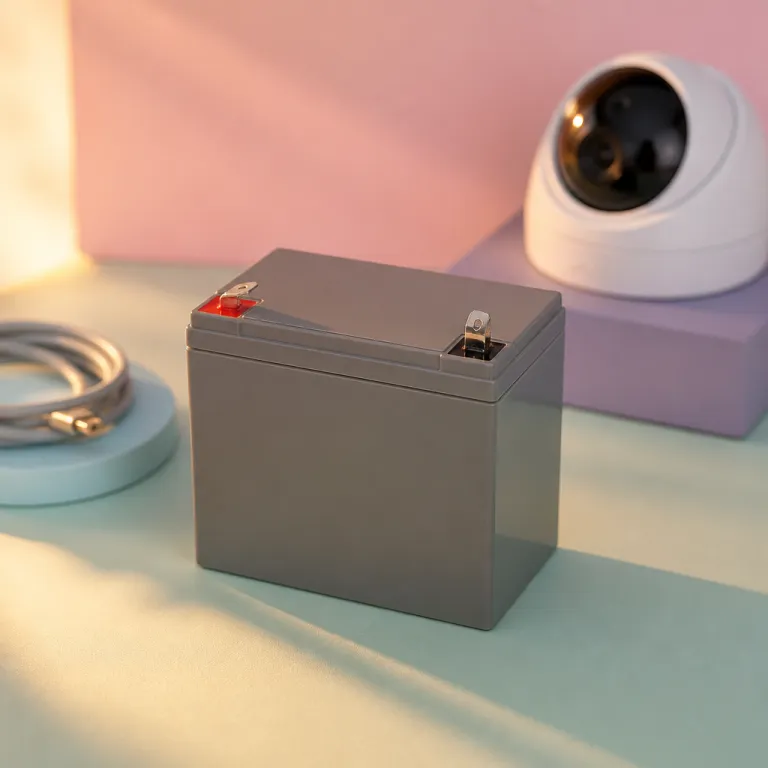
Why the upg sealed lead-acid battery ub1250 matters for home security uptime
Home security cameras are only as dependable as the backup power behind them. When you choose a UPG sealed lead-acid battery UB1250 as the core standby power source, you are effectively deciding how often your cameras go offline and how consistently they keep recording during outages. A carefully selected 12 volt battery with the right amp hour (Ah) capacity can mean the difference between a missed incident and a clear recording.
This compact lead-acid unit is widely used as a replacement battery in wired camera backup boxes, network video recorder enclosures, and small uninterruptible power supplies. Because it is a sealed design, the UB1250 does not require topping up water, and the electrolyte is immobilised, which reduces maintenance for homeowners who simply want their system to work. In practice, a high quality sealed construction also reduces the risk of leaks near sensitive electronics such as routers, PoE switches, and camera hubs.
From a technical perspective, the UPG UB1250 is a valve regulated AGM (absorbed glass mat) battery, meaning the glass mat holds the electrolyte firmly around the lead plates. This valve regulated structure allows controlled gas release while keeping the acid inside, which is essential when the battery sits in a hallway cupboard or under a desk near children. Because this is a common format in the small SLA (sealed lead-acid) category, many alarm panels and camera backup modules are designed around this exact type, making replacement straightforward for both professionals and do-it-yourself users.
Matching solar panels and adapters with a sealed lead acid backup
Many homeowners now pair solar panels with their cameras, yet they still rely on a dependable battery to smooth out cloudy days and night-time operation. When a solar charge controller feeds a UB1250, the panel, adapter, and battery must be matched for voltage, charging profile, and amp hours to avoid premature wear. A correctly sized solar kit can keep the SLA unit in its optimal charge window, extending service life and protecting your investment.
For roof-mounted or wall-mounted solar powered security cameras, installers often use a small universal power adapter that charges a sealed lead-acid battery inside a junction box. In this configuration, the UB1250 acts as a buffer, absorbing daytime solar energy and releasing it steadily overnight, which keeps the camera streaming even when the panel is shaded. When you read product documentation carefully, you will often see the manufacturer specify a particular terminal style and overall length, width, and height envelope, all of which the UB1250 usually meets.
If you are comparing solar powered camera options, it helps to understand how the internal batteries differ from an external unit in a dedicated enclosure. Some integrated cameras use lithium packs, while others rely on a small AGM block similar in chemistry to the UB1250, and each type has distinct charging requirements. For a deeper look at how solar powered systems balance panels, adapters, and storage, you can consult a specialised guide on top solar powered security cameras for residential use, then compare those designs with an external SLA backup strategy.
Evaluating quality, price, and real-world performance for camera backups
When you shop for a UPG sealed lead-acid battery UB1250, you are not just buying a commodity battery, you are choosing how your security system behaves during blackouts. The apparent price difference between low tier batteries and a high quality brand product can look small on paper, yet it often translates into years of extra runtime and fewer emergency service calls. For homeowners, that means fewer late night alerts about cameras going offline and more confidence that recordings continue during storms.
Experienced installers usually read customer reviews with a critical eye, looking for comments about early failures, swelling cases, or inconsistent voltage under load. A reputable manufacturer that offers a clear replacement warranty on its SLA line signals that it stands behind the claimed amp hours and cycle life, which is especially important when the battery sits in a locked attic or external cabinet. In many cases, the UB1250 is chosen because its valve regulated AGM construction has a strong track record in alarm panels, access control, and small UPS units, all of which share similar loading patterns with camera systems.
For complex multi camera installations that combine solar panels, extended batteries, and wired power injectors, the choice of a universal backup module becomes even more critical. Detailed guides on solar panels, extended batteries, and year-round camera add-ons often highlight how a robust sealed lead-acid backup smooths out seasonal variations. In practice, using a consistent format like the UB1250 across several junction boxes simplifies maintenance, reduces stocking complexity, and allows technicians to swap a single replacement battery quickly when a unit finally reaches end of life.
Practical buying checklist: dimensions, terminals, and system compatibility
Before adding a UPG sealed lead-acid battery UB1250 to your cart, you should confirm that its physical dimensions match your existing enclosure. Manufacturers typically list length, width, and height measurements in millimetres, and even a few extra millimetres can prevent the battery from fitting under a panel cover. Checking these figures against your current sealed unit or the original product manual avoids frustrating returns and extra shipping costs.
The next critical detail is the terminal type, because home security devices use several different connector formats. Some alarm panels and camera backup boxes expect Faston spade terminals, while others use screw posts, and forcing the wrong connection can damage both the lead-acid battery and the wiring harness. When replacing an older SLA battery, always compare the image gallery on the retailer’s page with your existing unit, and if the website offers a skip-images option, still take the time to read the technical content that describes terminals and polarity.
Electrical compatibility matters just as much as physical fit, so verify that the voltage rating and amp hour capacity of the UPG model match the original specification. Using a higher capacity SLA of the same voltage can extend runtime, but only if the charger is designed to handle the extra loading and recharge time. If you are unsure, consult the security system manufacturer or a qualified installer, because an incorrect type of replacement battery can shorten lifespan or, in extreme cases, trigger safety cutoffs that leave cameras unpowered.
Installation, maintenance, and safety for sealed lead acid camera backups
Once you have the correct UPG sealed lead-acid battery UB1250 in hand, careful installation protects both your equipment and your warranty. Always power down the camera hub or alarm panel, note the polarity of the existing unit, and only then disconnect the old terminals to avoid accidental short circuits. When you connect the new lead-acid battery, ensure the terminal type mates firmly without wobble, because loose contacts can cause intermittent power loss that is hard to diagnose.
Although a sealed lead design is low maintenance, it still benefits from periodic checks, especially in hot lofts or cramped cupboards. Every six to twelve months, read the system’s diagnostics if available, or measure the resting voltage with a multimeter to confirm that the SLA battery is holding charge within the expected range. If you notice swelling, discolouration, or a strong acid smell, disconnect the universal power source immediately and arrange a replacement, as these are signs that the valve regulated safety features may be under stress.
Good practice also includes recording the installation date, expected service life, and any replacement warranty details in your home maintenance log. When several batteries share the same UPG label and similar amp hour ratings across different devices, replacing them in a staggered schedule can prevent multiple failures at once. For households that rely heavily on cameras for perimeter monitoring, treating the UB1250 as a scheduled maintenance item rather than a forgotten component significantly improves overall system reliability.
Security, privacy, and the hidden role of reliable backup power
Power resilience is not just a technical concern, it is a security and privacy issue for any modern home. If a criminal understands that cutting mains power or jamming a router can disable cameras whose SLA backup is already weak, they gain a tactical advantage. A robust UPG sealed lead-acid battery UB1250, correctly sized in amp hours and kept in good condition, makes that tactic far less effective.
Privacy conscious homeowners also worry about how long cameras keep recording during outages, especially when they monitor indoor spaces. A predictable sealed lead-acid backup window lets you design clear rules, such as how long footage is retained and when cameras should shut down gracefully to protect sensitive content. For readers interested in how attackers attempt to undermine surveillance, resources on camera scrambler tools and privacy protection show that power manipulation is only one of several techniques, yet it remains one of the easiest to counter with a reliable battery system.
From a broader perspective, using a universal power format like the UB1250 across alarms, routers, and camera hubs creates a more resilient household infrastructure. When every critical device shares the same replacement battery type, you can keep a small stock of spare units on a shelf, ready for quick swaps during emergencies. That simple step, combined with careful attention to loading, enclosure constraints, and manufacturer guidance, turns a humble lead-acid block into a quiet but essential guardian of your home’s digital perimeter.
Key figures on home security camera power and backup batteries
- Many consumer security cameras draw between 3 and 10 watts in continuous operation, which means a 12 volt SLA battery rated at 5 amp hours, such as the UPG sealed lead-acid battery UB1250, can typically provide several hours of backup for a single camera plus router under moderate loading (for example, a 10 watt load at 12 volts draws roughly 0.83 amps, so a 5 Ah battery offers about 6 hours at 100 % depth of discharge, or around 3 to 4 hours in real-world conditions).
- Manufacturer datasheets for alarm and camera power supplies commonly state that sealed lead-acid batteries in controlled indoor environments often last between 3 and 5 years before their usable capacity drops below 80 %, which is the typical replacement threshold recommended by universal power supply vendors.
- Testing reported in technical notes from major AGM battery brands shows that high quality valve regulated designs can deliver hundreds of shallow discharge cycles when kept between roughly 20 % and 80 % depth of discharge, while repeated deep discharges to near empty can cut that cycle life by more than half.
- In many regions, regulations and recycling programmes now require that more than 90 % of the lead content in spent sealed lead-acid batteries be recovered and reused, which significantly reduces the environmental impact compared with uncontrolled disposal.
| Specification | Typical UB1250 Value* |
|---|---|
| Nominal voltage | 12 V DC |
| Capacity | 5 Ah at 20-hour rate |
| Approx. dimensions (L × W × H) | ≈ 90 × 70 × 107 mm |
| Terminal type | Faston 0.187 or 0.250 (model dependent) |
*Always confirm exact values in the current UPG UB1250 datasheet before ordering, as specifications can change between production runs and regional variants.
FAQ: upg sealed-lead acid battery ub1250 and home security cameras
How long can a UPG sealed lead-acid battery UB1250 power a home security camera?
The runtime depends on the camera’s power draw, the router or hub load, and the health of the battery. For a typical combined load of 10 to 15 watts, a fully charged 12 volt, 5 amp hour SLA such as the UB1250 can often provide a few hours of backup. If multiple cameras share the same unit, the available time will decrease proportionally.
Is the UPG sealed lead-acid battery UB1250 safe to use indoors?
Yes, the UB1250 is a sealed, valve regulated AGM battery designed for indoor use in alarm panels, UPS units, and similar enclosures. It should be installed in a well ventilated but not exposed location, away from direct heat sources and moisture. As with any lead-acid product, damaged or swollen units should be replaced promptly and recycled through an approved collection point.
Can I use a higher capacity sealed lead acid battery instead of the UB1250?
You can sometimes use a higher amp hour battery of the same voltage, but only if the charger and enclosure are designed to handle the increased size and charging time. Always check the manufacturer documentation for the maximum supported capacity and physical length, width, and height dimensions. Installing an oversized battery without confirmation can stress the charger or prevent the panel from closing properly.
What should I check before buying a replacement UB1250 for my camera system?
Confirm the voltage, amp hour rating, and terminal type match your existing battery and the system specifications. Measure the old unit or read its label to verify length, width, and height, then compare those figures with the new product listing. Finally, review the replacement warranty terms and customer reviews to ensure you are getting a genuine UPG battery from a reputable seller.
How often should I replace the UPG sealed-lead acid battery UB1250 in my setup?
Most sealed lead-acid batteries in home security applications are replaced every 3 to 5 years, depending on temperature, loading, and discharge frequency. You can monitor performance by checking resting voltage and observing whether cameras or hubs shut down sooner during outages than they used to. When you notice a clear decline in runtime or any physical deformation, plan a proactive replacement to maintain reliable protection.