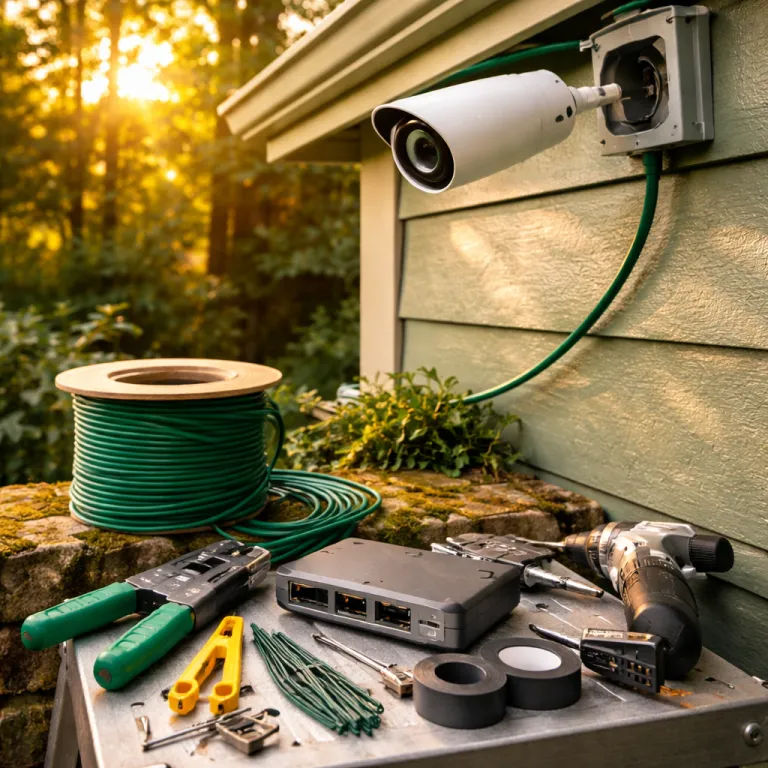
What a PoE security camera system really is
A PoE security camera system sends data and power through one Ethernet cable. That single line replaces the tangle of USB adapters, Wi‑Fi repeaters, and battery packs that many wireless security cameras need to stay alive. For a homeowner who is tired of recharging a wireless camera every few weeks, this shift to a wired poe system feels less like a gadget upgrade and more like basic infrastructure.
In practical terms, each poe camera connects back to a poe switch or directly to a poe NVR, which is a network video recorder that handles both recording and management. The same cable carries power and video, so you do not need a separate power outlet near the security camera, and you avoid the signal instability that plagues Wi‑Fi cameras at the edge of your router’s range. This is why serious installers still run Ethernet for their camera system even when wireless options look easier on the box.
Most modern poe cameras use Cat5e or Cat6 cable, which comfortably supports both 4K video and Power over Ethernet over typical home distances. A single 8 channel poe NVR can handle eight security cameras with continuous recording, smart motion detection, and remote access without leaning on a cloud subscription. When you add a decent sized hard drive inside that NVR, you gain predictable storage space and the ability to save weeks of footage locally instead of renting it back from a cloud service.
Reliability versus convenience: why poe security wins for serious protection
Anyone who has lived with Ring, Blink, or Arlo wireless cameras knows the pattern. The first weeks feel magical, then the batteries start dying faster, the Wi‑Fi drops during storms, and your most important clip is the one the cloud failed to save. A wired PoE security camera system attacks those weak points directly by removing batteries, reducing wireless dependence, and keeping recording on a local drive that you control.
Because a poe switch feeds power continuously, a poe camera does not throttle its bitrate or night vision just to stretch battery life. That means better video quality, more reliable night vision, and fewer gaps when motion triggers recording, especially when you use a dedicated poe NVR instead of a basic router and SD card. When a security system records to a local hard drive inside the NVR, even a broadband outage will not interrupt the video archive that matters most after a break in.
False alerts are another hidden reliability issue that pushes people away from cheap wireless security cameras. A well tuned wired camera system with decent AI features in the NVR can filter people, vehicles, and animals more accurately, especially when each channel has consistent bandwidth and power. If you are comparing a budget DVR kit with color night vision to a PoE setup, look at how each handles continuous recording, motion zones, and remote access before deciding which security camera or cameras will actually protect your home rather than just ping your phone all night.
For readers comparing older DVR technology with modern IP cameras, a detailed review of an 8 channel AI DVR camera system with color night vision offers a useful baseline before stepping up to full poe security. That kind of system shows what traditional coax based security cameras can do, while a PoE camera system builds on the same principles with better flexibility and network integration. The key difference is that PoE uses standard Ethernet and IP protocols, which makes future upgrades and mixed brand setups much easier to manage.
Cost breakdown: PoE versus wireless over the long term
On day one, a PoE security camera system often looks more expensive than a box of wireless cameras. You are paying for a poe NVR, a poe switch if the recorder does not have built in PoE ports, Ethernet cable, and sometimes professional installation. Over three to five years, though, the math usually flips once you factor in cloud subscriptions, battery replacements, and the hidden cost of missed footage when a wireless camera fails at the wrong moment.
A typical four camera PoE kit with an 8 channel poe NVR, preinstalled hard drive, and basic AI features often costs less than buying four premium wireless security cameras plus three years of cloud storage. Each wired security camera records continuously or on smart motion to a local drive, so you do not pay extra to save more than a few days of video. When you choose the best PoE option for your budget, focus on NVR reliability, storage space, and support for higher bitrate streams rather than chasing the highest megapixel number on the box.
There is also the cost of your time and frustration. Replacing batteries, troubleshooting Wi‑Fi interference, and dealing with subscription paywalls on basic features like activity zones or longer clip history all add up, especially if you manage several wireless cameras. A well chosen poe system with a quality poe switch, enough NVR channels for future expansion, and a large hard drive can run quietly in a cupboard for years with minimal attention, which is why many professionals still regard PoE as the best poe approach for serious home security.
If you want to see how high end PoE can look in practice, examine a review of a 4K PoE NVR CCTV camera system with PTZ and 2 TB hard drive. That kind of camera system shows what advanced features like cross camera tracking, color night recording, and large local storage can deliver without any monthly fee. It also highlights how a well designed poe system can combine fixed bullet cameras and a ptz poe camera to cover both wide areas and detailed zoom views.
Installation reality check: what it takes to wire a poe system
Running Ethernet for a PoE security camera system is not a five minute job. Expect to spend a weekend planning camera positions, drilling through walls or soffits, and fishing Cat6 cable through lofts or crawl spaces. The reward is a set of wired security cameras that simply work every time you open the app, without the usual wireless drama.
A typical home layout might use four to eight poe cameras covering front door, driveway, back garden, and side access points. Each camera home runs back to a central poe switch or directly into the NVR, which then connects to your router with a single network cable for remote access. This star topology keeps each channel independent, so a single cable fault only affects one camera rather than the whole security system.
Installation tools are basic but non negotiable. You will want a drill with masonry bits, a cable tester, a crimping tool if you are terminating your own RJ45 connectors, and weatherproof junction boxes to protect connections near each security camera. If that sounds daunting, hiring an installer for the cable runs while you handle NVR setup and app configuration can be a smart compromise that still gives you the long term benefits of a wired poe security setup.
Once the physical work is done, the digital setup is usually straightforward and close to plug and play. Most modern poe NVR interfaces auto detect connected cameras, assign them to a free channel, and guide you through basic settings like recording schedules, night vision modes, and remote access. At this stage you can fine tune each camera view, adjust color and exposure, and set motion zones so that your notifications focus on real threats rather than every passing car.
Choosing brands, features, and a hybrid strategy that actually works
Brand choice matters less than matching features to your home and your tolerance for tinkering. Reolink offers some of the best PoE value kits for homeowners who want a complete camera system with NVR, while Amcrest targets budget conscious buyers who still want decent image quality and reliable night vision. UniFi Protect appeals to network enthusiasts who like deep control and integration with other gear, and Hikvision remains a pro grade option often installed by contractors for larger properties.
When comparing specific security cameras, look beyond resolution and marketing claims about color night performance. Pay attention to sensor size, lens quality, bitrate options, and how the NVR handles smart features like human and vehicle detection or auto tracking on a ptz poe camera. A good PoE security camera system should support both standard fixed cameras and at least one PTZ unit for flexible view coverage, especially over large driveways or gardens.
Hybrid setups are often the sweet spot for real homes. Use wired poe cameras outdoors and in key indoor choke points where reliability and continuous recording matter most, then keep a few wireless cameras for temporary or low priority areas. If you are curious how a wireless PTZ with auto tracking and colour night vision behaves in practice, a detailed test of a 2K outdoor wireless PTZ security camera kit with auto tracking and colour night vision offers a useful comparison point against a wired poe camera in the same location.
Whatever mix you choose, insist on local storage options, clear documentation, and long term firmware support from the manufacturer. A PoE security camera system earns its keep not by looking sharp in the app on day one, but by quietly capturing usable video at three in the morning when something actually happens. That is the difference between a home that is genuinely protected and one that is only being watched.
FAQ
Is a PoE security camera system safer than wireless cameras for home use ?
A PoE security camera system is generally more reliable than a purely wireless setup because it does not depend on Wi‑Fi signal strength or battery life. Each camera receives both power and data through a dedicated Ethernet cable, which reduces dropouts and recording gaps. For most homeowners who prioritise consistent recording over quick installation, PoE is the safer long term choice.
Do I need an NVR for my PoE cameras, or can I record to a computer ?
You can technically record PoE camera streams to a computer or Network Attached Storage, but a dedicated NVR is usually simpler and more robust. An NVR is designed to run 24/7, manage multiple channels, and handle tasks like motion detection and remote access without constant tweaking. Using a computer for this role often leads to higher power use, more maintenance, and a greater risk of missed recordings when software crashes or updates.
How much storage space do I need on the hard drive for continuous recording ?
For a typical four camera PoE security camera system recording in 1080p with moderate bitrate, a 2 TB hard drive usually holds around two to four weeks of continuous footage. Higher resolutions, more cameras, or very busy scenes will reduce that retention time, while motion based recording can extend it significantly. When in doubt, choose a larger drive and an NVR that supports easy drive upgrades.
Can I mix PoE cameras from different brands on the same system ?
Many PoE cameras use the ONVIF standard, which allows them to work with NVRs from other manufacturers, but compatibility is not guaranteed for every feature. Basic video and audio usually work across brands, while advanced functions like smart motion detection or auto tracking may require matching camera and NVR ecosystems. If you plan a mixed brand setup, test one camera first with your chosen NVR before committing to a full system.
Is it worth paying extra for color night vision and PTZ PoE cameras ?
Colour night vision can make a real difference when you need to identify clothing colours or vehicle details in low light, especially around driveways and entrances. PTZ PoE cameras with auto tracking are valuable for large open areas, but they are overkill for small patios or narrow side paths where a fixed lens works fine. For most homes, a mix of fixed PoE cameras with good night vision and one well placed PTZ unit offers the best balance of coverage and cost.