
Summary
Editor's rating
Is the R2-4K DUAL actually good value for money?
Compact design that doesn’t scream “camera” in your face
Supercapacitor, power options and parking mode reality
Build quality and how it holds up day after day
Video quality, night vision and Wi‑Fi speed in real life
What you actually get and what it really does
Pros
- Clear 4K front + 1080p rear video with good night performance thanks to STARVIS 2 sensor
- Very complete kit (rear cam, mounts, charger, 128GB card, cables) so you can install it right away
- Fast 5 GHz Wi‑Fi and decent app make it realistic to pull 4K clips to your phone
Cons
- Parking mode requires a separate hardwire kit and extra installation work
- Menus and settings are a bit dense for beginners and the app can occasionally be finicky

Specifications
View full product page →| Brand | ROVE |
A dual dash cam that’s actually usable day to day
I’ve been running the ROVE R2-4K DUAL in my car for a bit now, front and rear, and overall it feels like a very practical, no-nonsense dash cam. I’m not someone who enjoys messing with settings for hours or running wires every weekend. I wanted something I could mount once, set up in under an hour, and then mostly forget about until I need the footage. On that front, this camera does the job pretty well.
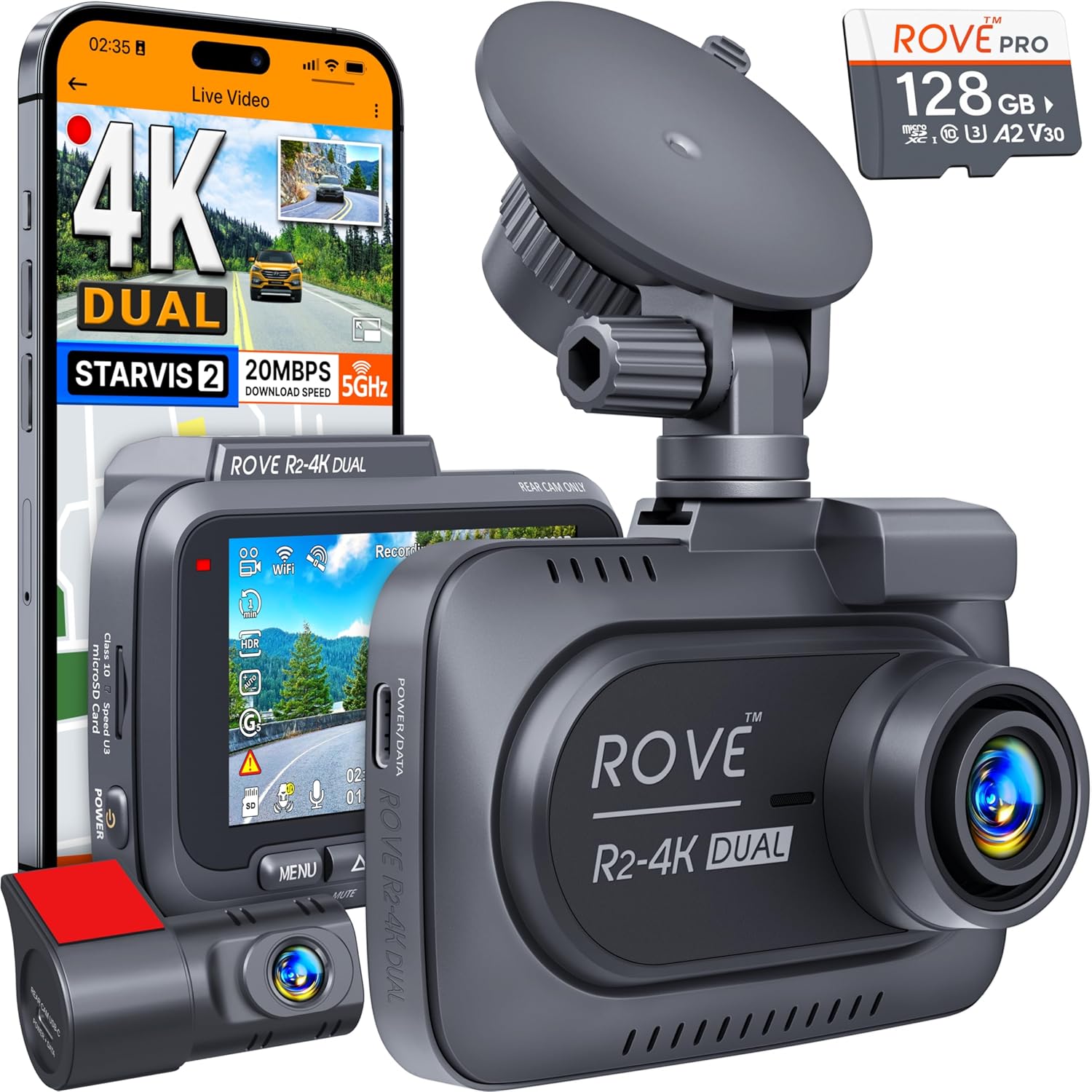
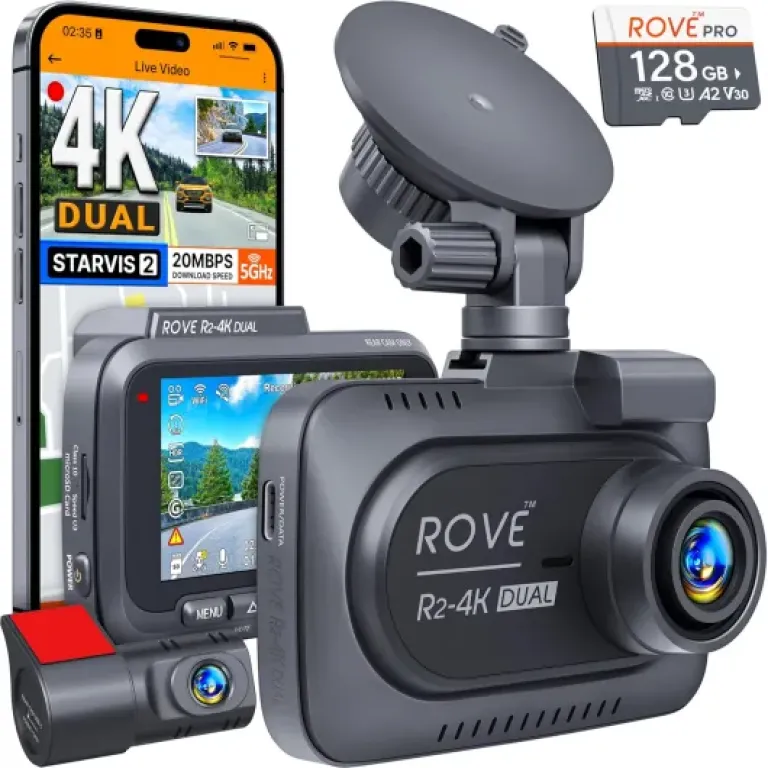
The kit is very complete: front cam, rear cam, long rear cable, dual USB charger, suction and sticky mounts, and even a 128GB microSD card already in the box. That’s honestly what pushed me to try it, because with other brands you often have to buy the card separately, and that’s another 20–30 bucks. Here you plug it in, format the card in the menu, and you’re ready to record.
During daily use, the two big things that stood out for me are the image quality and the Wi‑Fi speed. The 4K front footage is clear enough that plates are readable most of the time, even when you pause on a frame, and the Sony STARVIS 2 sensor does a decent job at night. The 5 GHz Wi‑Fi is genuinely faster than what I’ve seen on older dash cams; pulling short clips to my phone is noticeably quicker, especially for 4K files.
It’s not perfect, though. The parking mode requires a separate hardwire kit, the menus feel a bit crowded the first time you go through them, and the app is good but not flawless. But if you want a front + rear dash cam that’s pretty solid for the price, with a real 4K front image and GPS built in, this one is worth a look. Just don’t expect a luxury experience; it’s more of a practical tool than a fancy gadget.
Is the R2-4K DUAL actually good value for money?
In terms of value, this dash cam is pretty solid, mainly because it throws in a lot of stuff that other brands sell separately. The big one is the 128GB microSD card already in the box. Add to that the dual USB car charger, two different mounts, the rear camera with a long cable, and all the small accessories. By the time you add up what these extras would cost with another brand, the R2-4K starts to look like a fair deal, especially for a front 4K + rear 1080p setup with GPS and 5 GHz Wi‑Fi.
On the performance side, you get good video quality, solid night vision, decent GPS, and an app that actually makes Wi‑Fi transfers usable. It’s not perfect, but it’s more than enough for daily driving and for having clear evidence if something happens. Compared to cheaper 1080p‑only cams, you’re paying more, but you’re also getting much sharper footage and a more complete kit. Compared to very high‑end models, you’re saving money but giving up things like cloud storage or driver‑assist features, which most people won’t really miss.
The extra cost to unlock everything, though, is the hardwire kit for parking mode. If you want true 24/7 coverage, you need to buy that separately and either install it yourself or pay someone to do it. That adds to the bill. If you don’t care about parking mode and just want protection while driving, then the included accessories are enough and the value is better. So it depends a bit on how far you want to go with the install.
Overall, I’d say the R2-4K DUAL hits a nice middle ground: not the cheapest, not the most expensive, but good value for what it offers. If you just want a simple front cam and don’t care about rear footage or Wi‑Fi, you can save money with a basic model. But if you like the idea of front + rear, fast phone transfers, and having everything in one box, this one makes sense and doesn’t feel overpriced for what you get.
Compact design that doesn’t scream “camera” in your face
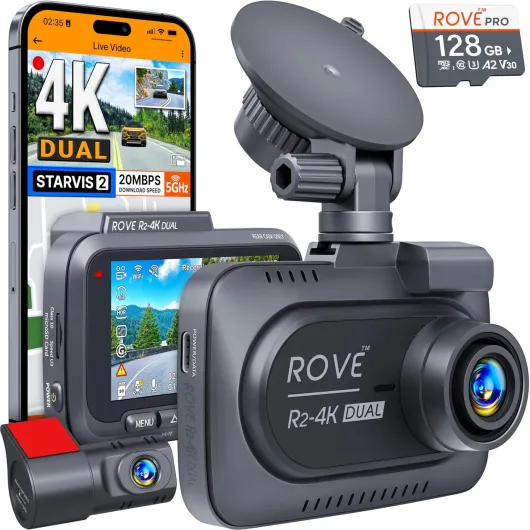
Physically, the R2-4K DUAL is pretty compact. The main unit is about 3.6 inches wide and 2.5 inches tall, so once it’s tucked behind the rear‑view mirror it doesn’t block much of your view. The black plastic housing is simple and low‑key. It doesn’t look premium, but it also doesn’t look cheap or toy‑like. It’s just a small black box with a screen on one side and the lens on the other, which is exactly what I want in a dash cam: something that blends in and doesn’t attract attention.
The screen is a 3" IPS panel. For a dash cam, that’s plenty. The viewing angles are fine, brightness is good enough even in daylight, and the menus are readable. You’re not watching movies on this thing; you’re checking framing and settings, and for that it works. The buttons sit along the side and are easy to reach when you’re parked, but not so big that you’ll constantly bump them while driving. There’s also a small ring of threads around the lens if you want to add a CPL filter later to cut reflections, which is a nice touch for people who like to tweak image quality.
I used the suction mount on my windshield, and it holds well. No sagging or falling off after a few days like some cheaper mounts. The mount allows 360° rotation, which makes it easy to tweak the angle or even quickly turn it toward the side window if something happens there. You also get a 3M sticky mount if you want a more permanent setup. Between the two, most people will find a setup that works for their car. The rear camera is small and light, so it doesn’t feel like you’re sticking a brick on your back window.
The only downside design‑wise is that once you have both the power cable and the rear cable plugged in, the front unit can look a bit cluttered with wires running out of it. That’s not unique to this model; that’s just dual dash cams in general. Using the included cable clips and tucking the wires under trim helps, but if you’re very picky about a super clean interior, you’ll have to spend a bit of time routing everything neatly. Overall though, the design is practical and discreet, not pretty, but it does the job without being annoying.
Supercapacitor, power options and parking mode reality
Technically, this dash cam doesn’t use a normal battery; it uses a supercapacitor. That means it doesn’t run for long on its own power like an action cam. Instead, it relies on your car’s power to record and the supercapacitor just gives it enough juice to save files safely when you turn the ignition off or if there’s a sudden power cut. In practice, that’s a good thing for longevity and heat resistance. Regular dash cam batteries tend to bloat or die after a year or two, especially if you park in the sun a lot. With the supercapacitor, you avoid that issue.
For daily driving, you just plug the included USB‑C power cable into the dual USB car charger and forget about it. The camera powers on with the car and shuts down properly when you turn it off. I didn’t have random shutdowns or weird restarts once I used the included cable and charger. One Amazon reviewer mentioned trouble when they tried to use a USB‑A extension; I had a similar experience when I first tried my own cable. The lesson is simple: use a good quality USB‑C to USB‑C or the included cable, otherwise the cam might get power but not behave correctly at startup.
About 24/7 parking mode: it’s there, and it works, but only if you buy the separate hardwire kit (ASIN: B0B7235VLX). Once you have that installed, you get three options: 1 fps timelapse, motion detection, and collision detection. If something happens while parked, the cam records a 1‑minute clip, locks it, and gives you a voice alert when you start the car. In my tests, motion and collision triggers worked, but like any parking mode, it depends a lot on how sensitive you set it and where you park. If you park on a busy street, you might get more events than you’d like.
So in short, don’t think of this as a device with a real internal battery. Think of it as a hard‑wired tool that stays on when the car feeds it power and safely saves its files when that power stops. For parking mode, factor in the extra cost and effort of the hardwire kit. If you just plug it into the cigarette lighter, it will only record while the car is on, which is fine for a lot of people but not full 24/7 coverage.
Build quality and how it holds up day after day
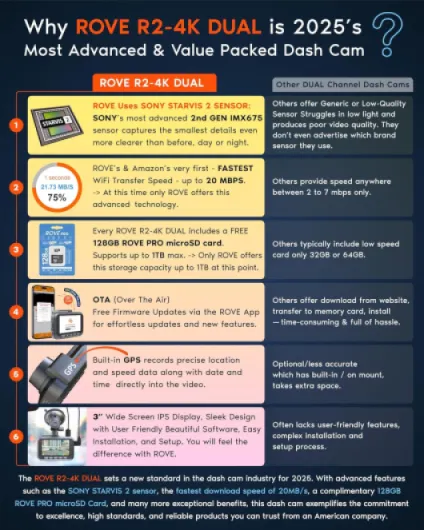
From a durability angle, the R2-4K DUAL feels solid enough for everyday use, without trying to be fancy. The plastic casing doesn’t creak, the buttons have a clear click, and the mounts don’t feel flimsy. The big plus is the supercapacitor instead of a lithium battery. That alone should help the camera last longer in hot or cold weather. I’ve had cheap dash cams with internal batteries literally swell up after one summer. This one is built specifically to avoid that kind of problem.
In daily use, the suction mount stayed put on my windshield without drama. No surprise drops after a few hot days, which I’ve had with other brands. The rear camera cable is fairly thick and doesn’t feel like it will tear if you accidentally snag it while loading something in the back. The included cable clips and trim tool also help you route and protect the cable properly, which in the long run prevents wear and accidental pulls.
The buttons and ports (USB‑C, rear cam port, microSD slot) are all fairly tight and don’t wiggle. The microSD card clicks in securely. Since it supports up to 1 TB cards, I appreciate that the slot feels firm and not loose. I formatted the included 128GB card in the camera itself, and after multiple days of loop recording, locking clips, and pulling files, I didn’t see any corruption or weird behavior. That’s not a long‑term test, but it’s a good start.
Of course, long‑term durability is something you only really know after a year or two. But based on the build, the use of a supercapacitor, and the fact that ROVE seems responsive on customer support (judging by other buyers who got quick help), I’m reasonably confident this will hold up better than the cheapest no‑name dash cams. It’s not indestructible, but for the price bracket it sits in, it feels like a safe bet if you want something that can live in your car full time.
Video quality, night vision and Wi‑Fi speed in real life
On the performance side, the front 4K footage is the main reason to buy this. During the day, the image is sharp, colors are natural, and license plates are readable in most normal situations. If a car cuts you off or someone brakes hard in front, you can usually pause the video and clearly see the plate and the model. The 150° field of view is wide enough to catch cars in the neighboring lanes without turning everything into a fisheye mess. HDR helps keep sky and shaded areas balanced so you’re not looking at a blown‑out white sky all the time.
At night, the Sony STARVIS 2 sensor plus the f/1.5 lens on the front and f/1.8 on the rear do a pretty solid job. It’s not magic: if a plate is dirty or a car is far away, you won’t see it perfectly. But in street‑lit areas and with headlights on, you can still recognize cars, lane markings, and signs. Headlight flares are present but manageable. Compared to older 1080p dash cams I’ve used, the R2-4K clearly keeps more detail in dark scenes. The rear 1080p camera is a bit softer than the front, which is expected, but still fully usable for evidence.
The G‑sensor and emergency lock work as they should. I tested it by tapping the mount while parked and doing some harder braking on an empty road. The camera automatically locked those clips so they didn’t get overwritten by loop recording. Loop recording itself is seamless; I didn’t notice any gaps between files. GPS performance is fine: speed and route data show up in the ROVE PC/Mac player, and the live speed on the screen is close enough to my car’s speedometer that I trust it.
The Wi‑Fi performance is where this model stands out a bit. The 5 GHz connection really is faster than the usual 2.4 GHz only cams. Pulling a 1–2 minute 4K clip to my phone is reasonably quick. You’re not waiting ages like on some older models. The app isn’t perfect (I had one or two occasions where it didn’t connect on the first try), but once it’s linked, browsing and downloading clips is straightforward. Overall, in daily use, the performance is reliable and consistent, which for a dash cam is more important than fancy features you never touch.
What you actually get and what it really does
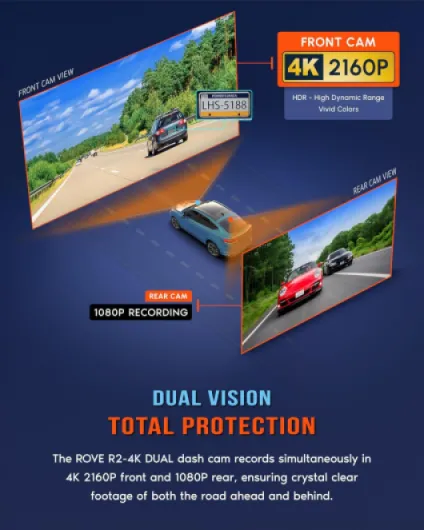
The ROVE R2-4K DUAL is basically a compact front dash cam with a separate little rear camera that you stick on the back window. The front unit has a 3" IPS screen, records up to 4K (3840x2160 @ 30 fps), and the rear goes up to 1080p @ 30 fps. Field of view is 150° front and 140° rear, so it covers a lot of what’s happening around the car. The front camera uses a Sony STARVIS 2 sensor with an f/1.5 lens, which is one reason the night shots are decent instead of muddy.
In the box you get pretty much everything: two mounts (suction and sticky), a long 6.5 m cable for the rear cam, a 3.5 m USB‑C power cable, a dual USB car charger, cable clips, films and wipes for the glass, and that 128GB microSD card. For a normal user, that’s enough to do a full install without going back to Amazon for missing bits. It can support up to 1 TB cards, but honestly 128GB is already plenty for daily driving unless you’re on the road all day.
Function‑wise, it’s loaded: loop recording, G‑sensor, emergency lock, 24/7 parking modes (timelapse, motion, collision), built‑in GPS with speed and route logging, and 5 GHz + 2.4 GHz Wi‑Fi to connect to the ROVE app. It uses a supercapacitor instead of a battery, which is better for heat and long‑term reliability, especially if your car bakes in the sun. There’s also voice guidance, which sounds like a gimmick but actually helps when you’re setting up parking mode or formatting the card.
In practice, most people will use maybe 30–40% of the features regularly: basic recording, grabbing clips through the app, checking speed after an incident, and maybe the parking mode if they hardwire it. The rest is nice to have but not essential. Overall, the feature set is packed for the price, but it also means the menus can feel a bit dense at first. If you just take 10–15 minutes to go through the main options once, it’s manageable, but don’t expect a super minimalist, Apple‑style interface.
Pros
- Clear 4K front + 1080p rear video with good night performance thanks to STARVIS 2 sensor
- Very complete kit (rear cam, mounts, charger, 128GB card, cables) so you can install it right away
- Fast 5 GHz Wi‑Fi and decent app make it realistic to pull 4K clips to your phone
Cons
- Parking mode requires a separate hardwire kit and extra installation work
- Menus and settings are a bit dense for beginners and the app can occasionally be finicky
Conclusion
Editor's rating
Overall, the ROVE R2-4K DUAL is a practical, well-equipped dash cam that focuses more on doing the basics right than on looking fancy. The front 4K footage is clear, the rear 1080p is perfectly usable, and the Sony STARVIS 2 sensor handles night driving better than a lot of cheaper cams I’ve tried. The built-in GPS, 5 GHz Wi‑Fi, and included 128GB card make it feel like a complete package rather than a starting point that forces you to buy extras.
It’s not flawless: the menus can feel busy, the app sometimes needs a second try to connect, and if you want real 24/7 parking surveillance you’ll have to buy and install the hardwire kit. Also, once both cables are plugged in, you’ll need to spend a bit of time hiding wires if you want a clean look. But day to day, it turns on, records, and saves clips without drama, which is exactly what you want from a dash cam.
If you’re a regular driver who wants front and rear coverage, solid video quality, and easy access to clips on your phone, this model is a strong option. It’s especially interesting if you don’t want to think about SD cards and accessories because the box is already loaded. If you’re on a very tight budget or only want a simple front camera with no GPS or Wi‑Fi, you can go cheaper. And if you’re chasing high-end extras like cloud backup and driver assistance, you’ll need to look higher up the range. For most everyday drivers, though, this is a good balance of features and price that gets the job done without being a headache.