
Summary
Editor's rating
Value: worth it if you actually need 24/7 recording
Design: just a standard 3.5" drive in purple clothes
Durability and 24/7 use: built to grind, but still a hard drive
Performance: great for constant recording, meh for desktop speed
What this WD Purple 10TB actually is (and isn’t)
Effectiveness for surveillance: how it actually changes your CCTV setup
Pros
- Handles 24/7 recording from multiple cameras without obvious stuttering or dropped footage
- Big 10TB capacity gives much longer retention compared to 1–2TB drives
- Surveillance-focused firmware (AllFrame) and 3-year warranty make it better suited for NVR/DVR use than a standard desktop HDD
Cons
- Not very fast for general desktop use, especially once you look past write caching tricks
- Runs a bit warm in tight, poorly ventilated DVR cases, so airflow matters

Specifications
View full product page →| Brand | Western Digital |
A big purple brick for your cameras
I picked up the 10TB WD Purple (model WD102PURZ) to upgrade an older NVR at home that was stuck on a 2TB drive and constantly overwriting footage after just a few days. I’ve used Western Digital drives for years in desktops and NAS boxes, but this was my first time going for their surveillance line instead of a regular desktop or NAS drive. My setup isn’t crazy, but it’s more than the typical 4-camera kit: I’m running 8 IP cameras at 1080p and one at 4MP, recording 24/7 to a basic NVR box.
In practice, I wanted three things: more retention (at least a couple of weeks), something that can spin 24/7 without whining or dying in six months, and no headaches with compatibility. I’m not chasing benchmarks on a drive like this; I just want it to quietly store video and not choke when I scrub through footage. So I dropped this 10TB WD Purple in and let it run for a few weeks before giving an opinion.
Overall, it feels like what it is: a big, purpose-built drive that’s not flashy, not especially fast on paper, but tuned for constant writes and lots of camera streams. It’s not perfect — it runs a bit warm, and it’s not the fastest thing if you try to use it like a normal PC drive. But for surveillance use, it mostly behaves the way the marketing claims, just in a much more boring, real-world way.
If you’re expecting miracles or desktop-SSD-style speed, you’ll be disappointed. If you just need a chunky, reasonably quiet drive that can sit in a DVR/NVR and take abuse 24/7, this one makes sense. The Amazon rating around 4.6/5 actually lines up with my experience: solid overall, with a few quirks you should know before buying.
Value: worth it if you actually need 24/7 recording
On the value side, this 10TB WD Purple isn’t the cheapest 10TB drive you can buy, but it’s also not outrageously priced, especially considering what it’s designed for. You’re paying a bit extra for the surveillance tuning and the fact that it’s meant to run 24/7 with multiple video streams. If you only have a couple of cameras and you record motion only, a smaller and cheaper drive might be enough. But if you’re like me and want at least a couple of weeks of history with full-time recording, 10TB starts to look reasonable.
Compared to using a standard desktop drive, the value shows up more over time. Desktop drives are cheaper, but they’re not really built for this constant write workload. If you burn through a cheap drive every year or two, the savings disappear quickly, not to mention the headache of losing footage or having to replace the drive. The Purple line is made for this sort of abuse, so you’re basically paying for peace of mind and fewer replacements. For a home or small business security setup, that’s worth something.
I wouldn’t buy this as a general-purpose storage drive for a PC; for that, I’d either go for a cheaper desktop 10TB or a NAS drive depending on the use case. The WD Purple shines specifically when you treat it as a dedicated CCTV/NVR disk. If that’s your scenario, the price per TB is fair, and the benefit of longer retention plus better stability makes it feel like money well spent instead of overkill.
So my take: good value for surveillance, average value if you try to use it outside its intended role. If your recorder or NVR is the heart of your home or shop security, spending a bit more on a drive that’s actually built for that job makes sense. If you just need a big bucket for random files, there are better options for the same or less money.
Design: just a standard 3.5" drive in purple clothes
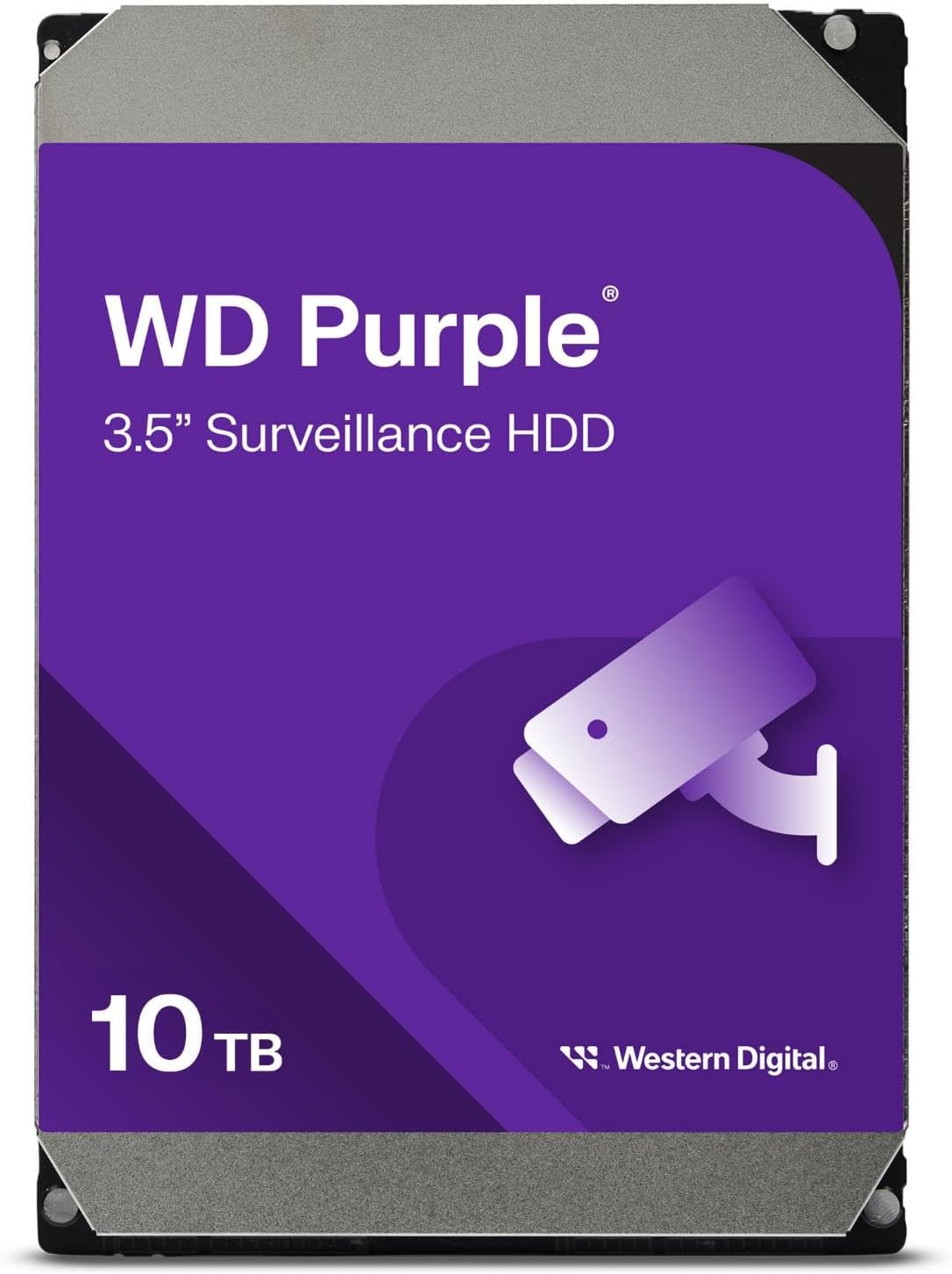
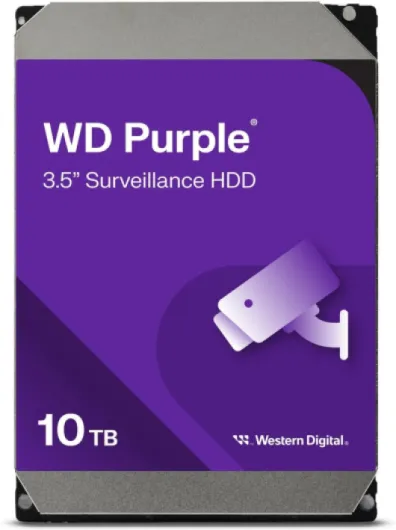
Physically, the WD Purple 10TB looks like every other 3.5" hard drive you’ve ever seen. Metal body, standard SATA power and data connectors, and the usual mounting holes on the sides and bottom. The only thing that stands out is the purple label, which is honestly just branding. If you’ve swapped drives in a DVR or PC before, this will feel familiar. I installed it in both a basic NVR chassis and a mid-tower PC case during testing, and it fit perfectly in both with standard screws.
The dimensions (about 1.03 x 5.79 x 4 inches, around 1.58 pounds) are standard for a 10TB 3.5" unit. It’s not especially slim or compact; it’s just a normal full-size drive. That’s fine for DVRs and NVRs, which are usually built with a 3.5" bay anyway. If you’re trying to cram this into a tiny mini-PC or some weird small form factor case, you’ll need an enclosure or adapter like you would with any other 3.5" drive. Nothing special here, but at least there are no surprises.
One thing I did pay attention to was vibration and noise from a physical standpoint. The drive has no extra dampening or rubber mounts built-in – that part depends on your case or recorder. In my NVR, which is basically thin metal, you can hear a faint hum if you’re close, but once the cover is on and it’s under the TV, it’s barely noticeable. In my PC case with proper rubber-grommet mounts, the drive feels a lot calmer, with less transmitted vibration. So the design is fine, but if your DVR case is cheap and tinny, expect a bit of resonance.
Overall, the design is plain and functional. No LEDs, no fancy casing, no nonsense. It’s a “stick it inside and forget it” type of product. For a surveillance drive, that’s exactly what I expect. Just don’t buy it thinking you’re getting some rugged, shock-proof tank — it’s still a standard HDD, so treat it like one and avoid dropping it on the floor during install.
Durability and 24/7 use: built to grind, but still a hard drive
The main reason to pay extra for a surveillance drive is durability under constant load. This thing is meant to spin 24/7 in a hot DVR box with cameras writing to it all day. I’ve had it running non-stop for several weeks now, and so far there are no signs of trouble: no weird clicking, no sudden disconnects, SMART data looks clean (no reallocated sectors, temps stable in the mid-40s °C inside the NVR, low 40s in a PC case with better airflow).
Compared to a regular desktop drive I used before, the Purple feels more stable under continuous use. My old 1TB drive started throwing SMART warnings after about a year of 24/7 CCTV duty. It wasn’t meant for that workload. This WD Purple is actually rated and marketed for that kind of abuse. The 3-year limited warranty is decent, not crazy generous but standard for this category. The fact that WD has been selling this Purple line for years and it’s still not discontinued also gives some confidence — it’s not some experimental product.
That said, it’s still a mechanical hard drive. If your NVR lives in a hot attic with no ventilation, or you keep bumping or moving the recorder while it’s on, don’t expect miracles. I’d still recommend giving it at least minimal airflow and not stacking it directly on top of another hot drive if you can avoid it. Heat kills drives over time, no matter the marketing. I’d also keep a backup of any critical footage you really care about, just like with any storage device.
From reading other user reviews and my own experience so far, I’d say reliability seems pretty good overall, but there are always a few people who get a bad unit, like with any hard drive. If you buy it, I’d run a quick extended SMART test at the start and let it do a full write/read pass before trusting it with something important. Once it passes that and runs a few weeks without errors, I’d feel comfortable leaving it alone in an NVR for years.
Performance: great for constant recording, meh for desktop speed
Performance-wise, this drive is clearly tuned for continuous writing rather than quick file transfers or running apps. In my NVR with 9 cameras, all recording 24/7 (eight at 1080p, one at 4MP), it handled the load without any obvious frame drops or stuttering. I scrubbed through random days and times, including times when motion detection was going crazy, and the playback was smooth enough. That’s the main thing I care about for surveillance: is the footage there, and does it play back without gaps?
I also did some quick tests in a Windows PC to see how it behaves as a normal drive. With write caching enabled (which is on by default in Windows), large file transfers look decent at first, but just like one Amazon reviewer pointed out, a lot of that is the cache and the OS giving you the illusion that the write is already done. If you disable write caching, you see the real raw speed: it’s clearly slower than a performance desktop HDD or any SSD. For storing large video files, that’s fine. For installing games or working off it daily, it feels sluggish.
What I did notice is that the drive is consistent. Even when it’s being hammered by the NVR, it doesn’t spike or drop massively. That matters more than peak speed for this use case. When all cameras are recording and I’m remotely scrubbing through footage from my phone, the NVR keeps up without choking. With my old 1TB desktop drive, the system used to lag or freeze for a second when I jumped around the timeline. With the WD Purple 10TB, those pauses are shorter and less frequent.
So in plain terms: for CCTV and NVR use, the performance is solid and predictable. For general PC storage, it’s fine for cold storage or backups but not great as a main system drive. If you buy it for the right job (surveillance or continuous recording), it gets the job done well. If you expect it to feel snappy like an SSD or even a high-end NAS drive, you’ll be underwhelmed.
What this WD Purple 10TB actually is (and isn’t)
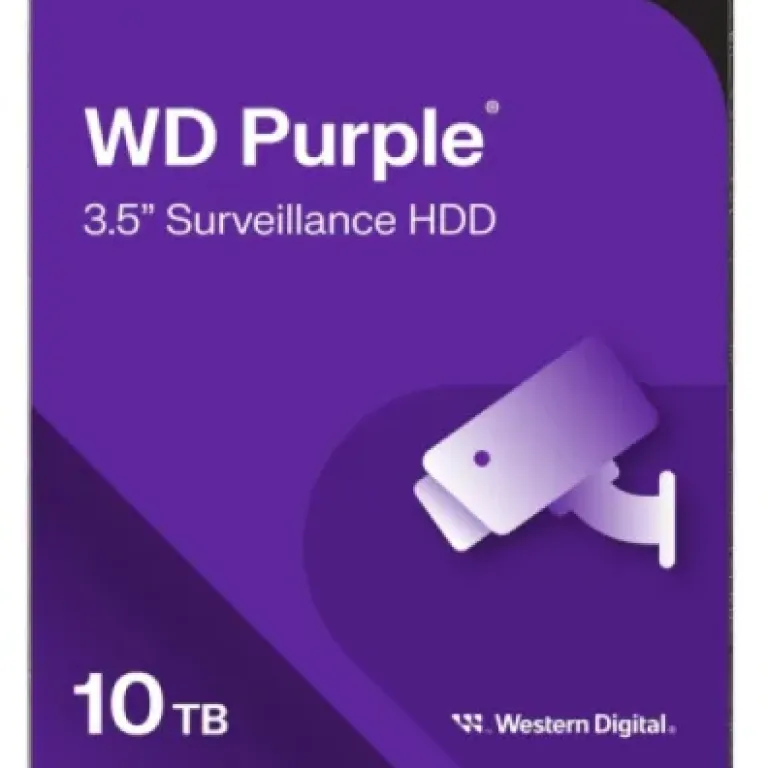
On paper, the WD Purple 10TB is a 3.5" mechanical hard drive, SATA 6 Gb/s, 7200 RPM, with a 256 MB cache and a workload rating tuned for constant video recording. Western Digital markets it for 24/7 surveillance, up to 64 HD cameras. That doesn’t mean you should plug 64 cameras into your house, it just means the drive firmware is tuned to handle lots of simultaneous video streams without freaking out or dropping frames. My setup with 9 cameras barely pushes it compared to that spec.
In practice, it behaves like a normal SATA drive when you plug it into a PC or NVR: the system sees a 10TB disk, you format it, and that’s it. There’s no fancy software, no extra junk. The special part is mostly firmware and error handling: the drive is designed to prioritize continuous writes over random small reads and heavy multitasking. That’s good for CCTV, less ideal if you try to run a full desktop OS and games off it. I tested it briefly in a Windows machine: it works fine, but you can feel it’s not tuned for that.
Western Digital also pushes their AllFrame technology, which is basically their way of saying the drive handles video streams in a way that reduces dropped frames and pixelation. I can’t scientifically measure that, but I did compare footage from my old 1TB desktop drive vs this one: when scrubbing through recorded video, I noticed fewer little hiccups or missing seconds, especially when all cameras were active. Could be the bigger cache and firmware, could be placebo, but day-to-day it does feel smoother.
So if you’re wondering what you’re paying for vs a normal 10TB desktop drive: you’re mainly getting firmware tuned for video, better handling of constant writes, and a drive that’s meant to sit spinning 24/7. You’re not getting blazing transfer speeds or anything fancy visually. It’s basically a specialist tool: boring, focused, and built to just sit there and record.
Effectiveness for surveillance: how it actually changes your CCTV setup
For actual day-to-day surveillance use, this drive mainly changes one thing: how long you can keep your recordings. Going from a 1TB drive to 10TB in my setup turned my retention from about 4–5 days to just over two weeks at full 24/7 recording on 9 cameras. That lines up pretty well with what one of the Amazon reviewers described. If you tweak your settings (like using motion-only recording or slightly lower bitrates), you could easily stretch that to a month or more, especially if you have fewer cameras or only 1080p.
The second thing is that it feels more stable under constant recording. My NVR used to randomly freeze for a second when I tried to review footage while it was recording. With the WD Purple 10TB, those hiccups are a lot less common. I can jump back a few hours, fast-forward, and the playback stays mostly smooth. That’s where this whole AllFrame video tech and surveillance tuning seems to show up in real life. It’s not magic, but it does make the system feel more reliable when you actually need to check something.
In terms of compatibility, it was basically plug-and-play. I swapped it into my NVR, powered on, and the system immediately asked to format the new disk. After that, the cameras came back online and started recording. No weird firmware updates or driver issues. I also tried it in another brand DVR for a friend (a Swann box), and it worked fine there too. So when WD says it’s “engineered for compatibility,” that part actually lines up with my experience.
So as a surveillance drive, it does what it’s supposed to: long retention, stable recording, and smooth enough playback. It doesn’t magically improve camera quality or turn a cheap DVR into a pro system, but it removes the weak link of having a tiny, overworked drive that constantly overwrites and stutters. If you’re serious about having usable footage when something happens, this kind of drive makes more sense than reusing an old desktop HDD.
Pros
- Handles 24/7 recording from multiple cameras without obvious stuttering or dropped footage
- Big 10TB capacity gives much longer retention compared to 1–2TB drives
- Surveillance-focused firmware (AllFrame) and 3-year warranty make it better suited for NVR/DVR use than a standard desktop HDD
Cons
- Not very fast for general desktop use, especially once you look past write caching tricks
- Runs a bit warm in tight, poorly ventilated DVR cases, so airflow matters
Conclusion
Editor's rating
The WD Purple 10TB (WD102PURZ) is basically a big, purpose-built workhorse for CCTV systems. It’s not flashy, it’s not especially fast for desktop use, and it doesn’t try to be anything other than a surveillance drive. In my setup with 9 cameras running 24/7, it delivered what I actually care about: longer retention (from a few days to a couple of weeks), stable continuous recording, and fewer hiccups when scrubbing through footage. Installation was straightforward, and compatibility with common NVR/DVR brands seems solid.
It’s not perfect. It runs a bit warm in cramped cases, and if you try to use it as a general PC drive you’ll notice it’s slower than a performance HDD or SSD, especially once you disable write caching and look at the real speeds. And like any mechanical drive, it can still fail, so you shouldn’t treat it as bulletproof. But for its intended role — 24/7 surveillance storage — it feels like a pretty solid choice that just quietly does its job.
I’d recommend this to anyone with a home or small business CCTV system who wants more than a few days of footage and wants a drive that’s actually designed to handle constant recording. If you only have one or two cameras and light usage, you can probably save money with a smaller or cheaper drive. And if you’re looking for a fast drive for gaming or everyday PC work, this is the wrong product. Used for what it’s built for, though, it’s a reliable, no-drama option.