Summary
Editor's rating
Value: where this 6-cam kit makes sense and where it doesn’t
Design: chunky but practical, clearly built for mounting and forgetting
Battery & solar: mostly hands-off, but placement matters
Durability & reliability: how it holds up and how often it goes offline
Performance: image quality, tracking and alerts in real life use
What you actually get in the aosu 6‑cam kit
Pros
- No required subscription thanks to 32GB built-in storage on aosuBase, expandable up to 1TB
- Six 5MP solar‑powered pan & tilt cameras cover a full property with 360° views and human auto‑tracking
- Easy DIY setup with wire‑free installation and stable performance once installed
Cons
- Small delay between motion detection and recording can clip the start of some events
- Solar charging depends heavily on placement and sunlight, shaded spots may still need manual recharging

Specifications
View full product page →| Brand | aosu |
| Indoor/Outdoor Usage | Outdoor |
| Compatible Devices | Android, IOS, Smartphone |
| Power Source | Solar Power,Corded Electric |
| Connectivity Protocol | Bluetooth |
| Controller Type | Android |
| Mounting Type | Wall Mount |
| Video Capture Resolution | 5MP/3K |
A full wireless setup without monthly fees? Here’s how it really feels to use
I’ve been running this aosu 6‑camera solar kit around my house for a few weeks, replacing a mix of random Wi‑Fi cams and a Ring doorbell. I mainly wanted two things: no monthly subscription and not having to climb a ladder every couple of months to recharge batteries. On paper, this kit ticks both boxes: local storage on the aosuBase and solar charging on every camera.
In practice, it’s pretty close to what the product page promises, but not perfect. The whole thing really is easy to set up, the app is simple enough, and the picture quality is more than good enough to see faces, license plates at short distance, and what your dog is chewing in the yard. The 360° pan & tilt and auto-tracking work, though they’re not magic — there’s sometimes a small delay and the camera can over‑pan if someone moves quickly.
Where it stands out for me is the no‑subscription local storage and the fact you can cover a whole property with a single base. You plug the aosuBase into your router, pair each camera via the app, and you’re basically done. No cloud upsell screens every 5 minutes, which is honestly refreshing compared to Arlo/Ring. Notifications are reasonably fast, and the camera‑to‑camera tracking feature (one event, one notification) actually cuts down on spam alerts when someone walks across multiple zones.
It’s not all perfect. There is a bit of recording delay on motion, especially if you set it to human-only detection, and the night vision distance is decent but not crazy long. The hardware feels solid but still like consumer plastic, not pro gear. Overall though, if you want a straightforward, whole‑house wireless setup with no ongoing fees, this kit gets the job done without too much drama.
Value: where this 6-cam kit makes sense and where it doesn’t
For what you’re getting — six 5MP pan‑tilt cameras plus a base with local storage and no required subscription — the value is honestly pretty good. If you compare it to buying six individual Wi‑Fi cams from Ring, Arlo or Nest and then paying monthly for cloud storage, this aosu kit will usually come out cheaper within the first year or two. The fact that 32 GB of storage is built in and you can expand to 1 TB means you’re not forced into any ongoing fees unless you actually want cloud, which this system doesn’t even push hard.
Where it really makes sense is if you have a whole property to cover: front, back, sides, driveway, maybe a detached garage. Buying a couple of cameras piecemeal from different brands gets messy fast: different apps, different batteries, and different mounts. Here, it’s one app, one base, and everything behaves the same. The multi‑view of four cameras at once, the camera‑to‑camera event merging, and shared local storage all benefit from going with a full kit instead of mixing and matching.
On the downside, if you only need one or two cameras, this specific 6‑cam kit is probably overkill. You’d be better off with a smaller aosu bundle or a different brand altogether. Also, while the price is fair for six cameras, it’s still a decent chunk of money in one shot. And this isn’t a wired NVR system, so if you want rock‑solid wired reliability and 24/7 continuous recording on every channel, this isn’t that — it’s more event‑based, battery‑friendly recording.
Overall, in value for money, I’d say it’s a good deal for someone who wants to set up a complete, wireless, subscription‑free system once and be done. It’s not the cheapest way to get a single camera on your porch, but for covering a full house with one ecosystem and avoiding monthly payments, it hits a nice balance between cost, features, and hassle.
Design: chunky but practical, clearly built for mounting and forgetting
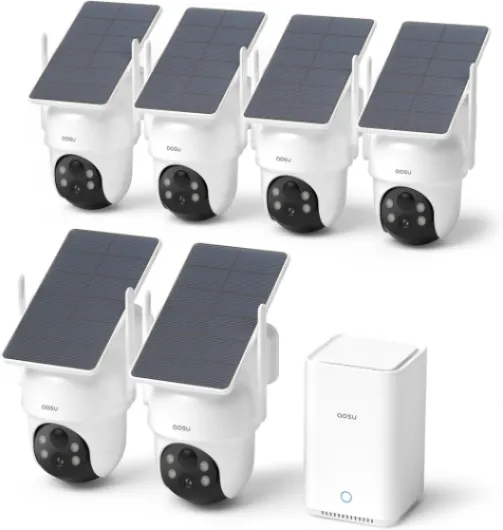
The design is very utilitarian. Each camera is a white dome with a small solar panel integrated on top and a mounting base that lets it rotate and tilt. It’s not what I’d call stylish, but once they’re up under the eaves or on a wall, they just look like normal security cameras. If you’re hoping for something discreet, these are a bit on the noticeable side, especially if you mount them low. On the other hand, the visibility can be a plus as a deterrent.
Mounting is pretty simple: three screws per bracket, then the camera clicks in. The nice thing is that the cameras pop off the mounts easily, so if you ever need to bring one inside to charge via USB‑C or adjust it, you’re not fighting with tools every time. I mounted two higher up on the second floor and didn’t feel like the brackets were flimsy; once tightened, there’s no wobble. They’re light enough that you don’t feel like they’ll rip out of vinyl siding, but solid enough that they don’t feel like toys.
Physically, the 360° pan & tilt means the lens sits inside a little dome housing that can rotate horizontally and vertically. You control that from the app with a simple joystick‑style control. The pan range is basically full 360° and tilt is more than enough to cover ground and some sky. In reality you’ll set a patrol area or just leave it pointed where you want, and let the auto‑tracking follow people when they appear.
One small downside: the solar panel is fixed on top. So if you mount the camera under a deep overhang or somewhere shaded, you might not get ideal sun. It’s fine in most spots, but if your house is awkward for sunlight, you may need to think about angles a bit more. Overall, the design is more about function than looks, and for a security kit, I’m okay with that. It feels like gear you install and basically forget about.
Battery & solar: mostly hands-off, but placement matters
The main selling point of this kit for me was not having to climb a ladder all the time. Each camera has a built‑in battery plus a solar panel. aosu claims that about three hours of sunlight per day is enough to keep them topped off. In my use, that’s roughly accurate for cameras that get direct or at least decent indirect sun. The battery level barely moved after the first week on the cameras facing south and west. On a more shaded side of the house, the battery did slowly dip over several very cloudy days, but it was still far from empty.
Where you mount them really matters. If you stick a camera under a deep porch roof or on a north‑facing wall with no sunlight, don’t expect miracles from the solar panel. The good news is they include a USB‑C charging cable and the cameras pop off the mount easily. So worst case, you bring a camera inside for a few hours to top it up. It’s not ideal, but at least you’re not unscrewing the whole bracket or dealing with weird proprietary connectors.
One Amazon user mentioned a battery not holding a charge after about seven months, and support fixed it with a firmware update to the base. That tells me the system isn’t flawless, but at least they’re actually supporting it and not just telling you to buy a new camera. I didn’t hit that specific issue, but I did notice that the cameras seem to manage power differently depending on how busy the area is. High‑traffic spots obviously drain more, especially if you use a lot of live view and two‑way audio.
Overall, I’d say battery and solar performance are good but not magic. If you give the panels a fair shot at the sun, it’s basically set‑and‑forget. In trickier spots, you’ll occasionally need to recharge via cable, but not every month like many battery‑only cameras. For a six‑camera setup, that’s a big plus: less ladder time, less hassle, and you can realistically cover the whole property without running power lines.
Durability & reliability: how it holds up and how often it goes offline
From a build quality standpoint, the cameras are mostly plastic but feel tight and well assembled. They’re not heavy metal housings like some wired pro cams, but they don’t creak or feel hollow either. Once mounted, they sit firmly in place. I’ve had them through rain and a couple of cold nights, and there were no leaks, fogging, or weird condensation inside the lens. Other buyers mention using them across seasons, including low temperatures around -10°C, without issues, which lines up with aosu’s claims.
Connectivity has been reliable. None of my cameras randomly dropped offline unless my own Wi‑Fi was acting up. That matches what a long‑time aosu user said in their review: the only times they saw disconnects were due to their router. The link between camera and aosuBase seems stable as long as you don’t push the range too far. If you try to mount a camera at the very edge of your property with several walls in between, you’ll probably see weaker signal, but that’s true for any Wi‑Fi system.
In terms of long‑term reliability, I obviously don’t have years of use yet, but some reviewers do, and they’re still happy. The main issues I’ve seen reported are: one or two defective units out of the box (replaced quickly by support), and the occasional battery or firmware quirk that got fixed by an update. The important bit is that the brand seems to actually respond and send replacements when needed, instead of leaving people hanging.
The aosuBase itself is a small box that just sits near your router. It runs quiet, doesn’t get hot, and so far hasn’t crashed on me. The fact that it stores everything locally means even if a camera gets stolen or smashed, your footage is still on the base. For home use, that’s a big reliability plus. Overall, I’d rate durability and reliability as pretty solid for the price bracket: not bulletproof industrial gear, but definitely good enough for a normal house or small business.
Performance: image quality, tracking and alerts in real life use
On the video quality side, the 5MP / 3K resolution is genuinely solid. Faces are clear at typical driveway and yard distances, and you can read license plates if the car isn’t too far away and there’s enough light. During the day, colors are decent and the picture is sharp without looking over‑processed. At night, you get a mix of standard IR night vision and what they call night color. Within about 30 feet, you can see people and objects clearly; beyond that, it’s more shapes than detail. For a normal yard or driveway, it’s fine, just don’t expect miracles at 50+ feet.
The 360° pan & tilt and human auto‑tracking are where this system feels more advanced than fixed bullet cams. When motion is detected, the camera can follow the person across the frame. When it works well, you end up with a single clip that shows the whole path instead of them walking in and out of frame. Sometimes it can lag a second or two and occasionally over‑shoot if someone moves fast, but overall it’s more helpful than annoying. You can also manually move the camera from the app if you want to scan an area.
Alerts are mostly reliable. I usually get a push notification within a couple of seconds of motion. However, like one Amazon reviewer mentioned, there is sometimes a small delay between motion detection and recording, so if someone just runs by quickly, you might only catch the second half of the action. With human detection on, the system ignores leaves and small animals pretty well, but that can also add a little processing delay. It’s a trade‑off: less spam alerts, but occasionally clipped starts to videos.
Streaming four cameras at once in the app works, but it does depend heavily on your Wi‑Fi and internet. On my mid‑range router, watching four feeds at once is smooth most of the time, with the occasional stutter. The good thing is all recording is local to the aosuBase, so even if the live view hiccups, the clips are still saved. Overall, performance is pretty solid for a consumer kit: not pro‑grade CCTV, but easily good enough for home use and checking what’s going on around your place.

What you actually get in the aosu 6‑cam kit
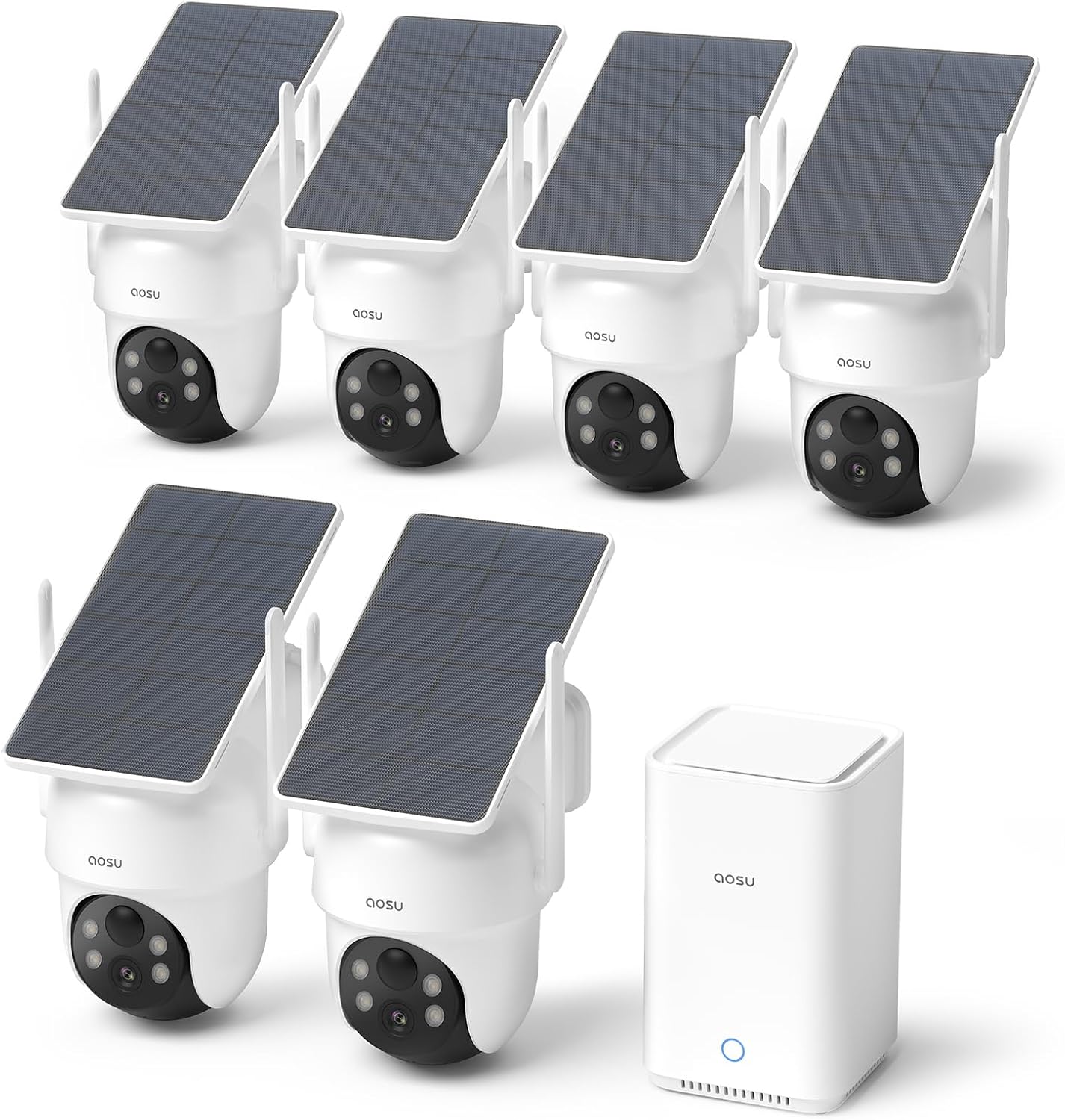
Out of the box, you’re getting six dome‑style wireless cameras, each with a solar panel on top, plus the aosuBase hub. The hub has 32 GB of built‑in storage and can be expanded up to 1 TB, which is a lot of room if you don’t keep every single clip forever. There’s also a power adapter for the base, an Ethernet cable to hook it to your router, mounting brackets for all six cameras, screws, positioning stickers, and a USB‑C cable for charging if you ever need it.
The cameras are 5MP (they call it 3K), do 360° pan & tilt, and support human auto‑tracking. These are meant for outdoor use: IP rating isn’t plastered everywhere in the listing, but they’re clearly built for being outside year‑round, and users are running them through rain and cold. They connect over Wi‑Fi to the base, and everything is controlled through the aosu app on Android or iOS. No NVR box with HDMI, no PC software — it’s very app‑centric.
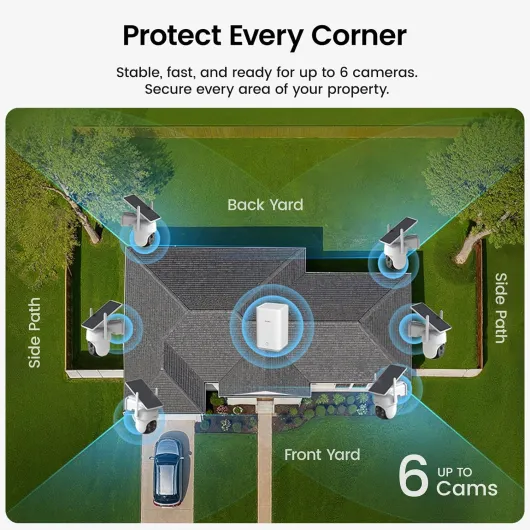
The aosuBase can handle up to six cameras, and this kit already maxes that out. So think of this as a full‑property starter pack: front door, driveway, backyard, both sides of the house, and maybe a shed or patio. The camera‑to‑camera tracking is a small but useful trick: when someone walks from the driveway past the side of the house, you don’t get six separate alerts; the system tries to merge it into one event. It’s not perfect, but it does cut down noise.
Overall, the presentation is pretty straightforward: this is a self‑contained, no‑subscription security system. You don’t have to buy an SD card to start, you don’t have to pay for cloud, and you don’t have to run power cables. If you want a simple kit that covers everything in one go, this package is built exactly for that, not for tinkering with separate brands and apps.
Pros
- No required subscription thanks to 32GB built-in storage on aosuBase, expandable up to 1TB
- Six 5MP solar‑powered pan & tilt cameras cover a full property with 360° views and human auto‑tracking
- Easy DIY setup with wire‑free installation and stable performance once installed
Cons
- Small delay between motion detection and recording can clip the start of some events
- Solar charging depends heavily on placement and sunlight, shaded spots may still need manual recharging
Conclusion
Editor's rating
As a whole package, the aosu 6‑Cam Solar Security Kit is a pretty solid choice if you want full‑property coverage without dealing with monthly subscriptions or a mess of cables. The setup really is quick, the app is straightforward, and the 5MP image quality is more than good enough for normal home security. The 360° pan & tilt with human auto‑tracking actually adds real value: you see more of what happened, not just a static corner of your yard. Solar power means much less ladder time, as long as you give the panels a reasonable shot at sunlight.
It’s not perfect. There can be a small delay between motion detection and recording, so very quick events might be clipped. Night vision is decent but not long‑range. The build is more consumer plastic than pro hardware, and if your house has lots of shaded spots, you may still need to recharge a camera by cable once in a while. But the local storage on the aosuBase, the ability to expand to 1 TB, and the overall reliability make it a good fit for homeowners who want a simple, all‑in‑one solution. If you only need one or two cameras, or if you’re looking for a wired, always‑recording NVR setup, this isn’t the right product. For everyone else who wants easy DIY install, app‑controlled cameras, and no ongoing fees, this kit is a strong, no‑nonsense option.