Summary
Editor's rating
Value for money: good if you know what you’re buying
Design: tiny, discreet… and a bit fragile
Battery and power: don’t count on it being truly wireless
Build quality and how it holds up with use
Image quality, motion alerts and Wi‑Fi: how it actually performs
What this mini spy cam actually offers (beyond the marketing)
Pros
- Very small and easy to hide, with two separate lenses for wider coverage
- Decent 1080p video quality and reliable motion alerts for basic monitoring
- Supports large microSD cards (up to 256 GB) and can run continuously when plugged in
Cons
- Short internal battery life (around 70–90 minutes) makes it basically a wired camera for real use
- Fragile lens cables and bare module design require careful handling and DIY mounting

Specifications
View full product page →| Brand | HiSpyCam |
A tiny camera for people who like to tinker
I’ve been playing with this HiSpyCam Dual Lens DIY module for about two weeks, mainly at home. I wanted something small I could hide on a shelf to keep an eye on the entrance and also see what my dog is doing when I’m out. I already have a couple of normal Wi‑Fi cameras, but they’re bulky and super obvious. This thing is the opposite: it’s tiny, it looks like random electronics, and you can stick the lenses pretty much anywhere.
From day one, my impression was: this is more a DIY component than a finished product. If you’re expecting a polished, plug‑and‑play indoor camera with a stand and nice casing, that’s not what this is. It’s a bare module with wires and two small lenses you need to hide or mount yourself. That’s both the fun and the pain: lots of freedom, but you also need to be a bit handy and careful.
In use, it does most of what the product page promises: 1080p video, motion alerts, Wi‑Fi viewing through the app, cloud or SD storage. It’s not fake. But the experience is not as smooth as big brands like Blink or Wyze. The app is okay, not great, and the internal battery is more like a short backup than a real cordless option. You quickly end up using it plugged into USB if you want anything close to continuous monitoring.
Overall, after these two weeks, I’d say it’s pretty solid for the price if you have a specific hidden‑cam project and you’re not scared by a couple of wires and a basic app. If you just want a simple baby cam you drop on a table and forget, there are easier options. But if you like to tinker and need something discreet, this one gets the job done.
Value for money: good if you know what you’re buying
Given the feature set and the fact that it’s sitting fairly high in the hidden camera rankings, the value for money is pretty solid, as long as you’re the right type of user. You get dual 1080p lenses, Wi‑Fi, motion alerts, local and optional cloud storage, and a very small form factor. For a brand that’s not a big name, the performance is decent and lines up with most of the 4‑star reviews. It’s not dirt cheap, but it’s also not crazy expensive compared to other spy cams.
Where the value can feel a bit weaker is if you treat it like a regular home camera. For roughly the same price, you can sometimes get a more polished indoor cam from a known brand with a better app, stronger casing, and easier mounting. You’ll lose the tiny size and dual lens, though. So it’s really a trade‑off: you’re paying for discretion and DIY flexibility, not for build quality and ecosystem. If you never use the dual lens feature and just hide it in one place, you might as well have bought a single‑lens mini cam for less.
The optional cloud storage is another factor. I personally stuck with SD card recording because I don’t feel like adding yet another subscription. The local recording works fine, and the camera supports up to 256 GB, which is plenty for looping footage. If you go for the cloud, that’s extra cost every month and eats into the value. On the upside, their base offer looked cheaper than some big names, but I didn’t test it long enough to judge long‑term reliability.
So in short: if you want a small, hideable module for a specific project, the price is fair and the product delivers enough to justify it. If you just need a simple living‑room camera with no tinkering, you’ll get better value from a more mainstream model with a proper housing and better software.
Design: tiny, discreet… and a bit fragile
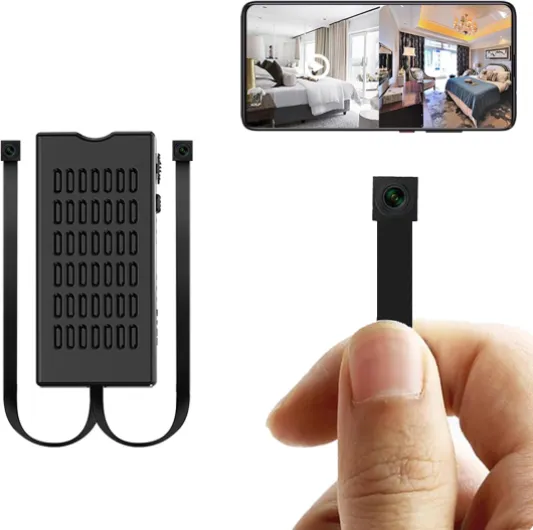
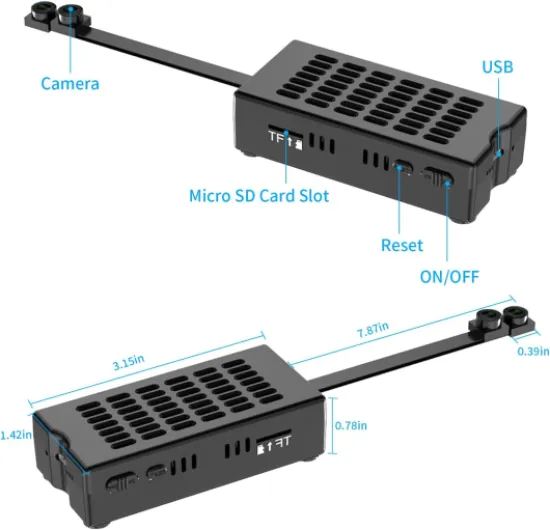
Design‑wise, this thing is really small. The main module is around 1 x 1 x 1 inch, basically a little cube of electronics. The two lenses are on thin flat cables that stick out from the board. That’s what makes it easy to hide: you can bury the main body in a box, a book spine, or behind a picture frame, and just route the lenses through a small hole. I put one lens through a fake plant and another between two books and nobody noticed anything unless I pointed it out.
The flip side is that it looks like a raw electronic component, not a finished consumer product. No real casing, no proper mounting system. You’re the one who has to figure out how to tape or glue it in place without messing up the cables. I ended up using double‑sided tape and a bit of hot glue in one setup. It works, but it’s DIY. If you’re clumsy, you’ll hate it. The included accessories are minimal: basically just the USB charging cable, no mounts, no brackets.
The cables to the lenses are the weak point. Several reviewers mentioned they’re delicate, and I agree. After a few days of adjusting the angle, I started being much more careful. They haven’t broken, but they don’t inspire confidence. If you plan to move the camera a lot, you’re asking for trouble. This is more like “install once and don’t touch too much” hardware. Also, because it’s so light, any small bump or cable pull can shift your framing if you haven’t fixed it down properly.
In terms of discreetness, though, it does the job. You can hide those tiny lenses in:
- a stuffed animal
- a vent grille
- a hollowed‑out book
- a router or speaker shell
Battery and power: don’t count on it being truly wireless
The weak point for me is battery life. The internal battery gives roughly 70–90 minutes, and that matches what other users said. I tested it twice: one session with continuous live view and one with motion‑based recording only. In both cases, I was around that 1–1.5 hour mark before it shut down. So if you’re dreaming of a tiny wireless cam you can drop somewhere for a full afternoon, forget it. The built‑in battery is more like a temporary backup or a way to test placements before you commit to a permanent power source.
In real use, I very quickly ended up running it plugged into a USB charger. That’s clearly how it’s meant to be used if you want 24/7 monitoring. The good thing is that it works fine while charging, and because the module is small, you can hide the cable fairly easily behind furniture or inside an object. But yeah, you’ll need a nearby outlet or a power bank if you want it in a weird spot. I did a test with a 10,000 mAh power bank and got several hours of use, which could work for temporary setups (like monitoring a car in a garage or something like that).
The brand sells it as battery powered, which is technically true, but in practice it’s a plug‑in device for anything serious. If you only need short bursts (like checking on a cleaner or a short babysitting session), you might squeeze by on battery. But if you want to constantly record or always be able to connect live, you’ll be disappointed if you rely only on the internal cell.
So my take: plan from the start how you’re going to power it long term. Hide a USB charger in a corner, run a cable through a piece of furniture, or use a decent power bank. Once you treat it like a wired camera with a small backup battery, the experience makes more sense.
Build quality and how it holds up with use
After two weeks of moving it around and trying different hiding spots, the module itself still works fine, but it doesn’t feel tough. This is not something I’d want kids to handle or something I’d throw in a bag without protection. The PCB is exposed, the lens cables are thin, and nothing is really reinforced. It’s the price you pay for the tiny size and DIY style. If you install it once and leave it alone, it’ll probably last. If you constantly bend the cables and pull it in and out of tight spaces, I can see it failing over time.
The camera is advertised as indoor/outdoor, but personally I would keep it indoors or at least very sheltered. There’s no proper casing or weather sealing. I tried it briefly in a covered balcony, and I was nervous about humidity and dust. It’s fine if you put it inside something (like a fake smoke detector shell or a waterproof box with a small opening for the lens), but out in the open, I wouldn’t trust it in rain or heavy dust.
The good news: the electronics didn’t overheat in my tests. I left it running plugged into USB for a full day in a closed decorative box, and it was warm but not scary hot. So thermally it seems okay. The microSD slot held the card fine, and I didn’t get corrupted files during my tests. Just be sure to use a decent card (Sandisk or similar), as the reviews and my own experience both point in that direction.
Overall, I’d rate durability as acceptable if you treat it gently and install it thoughtfully. It’s not a rugged security camera. Think of it like a little prototype board: if you’re careful, it’ll last; if you’re rough, you’ll probably break something, starting with those lens ribbons.
Image quality, motion alerts and Wi‑Fi: how it actually performs
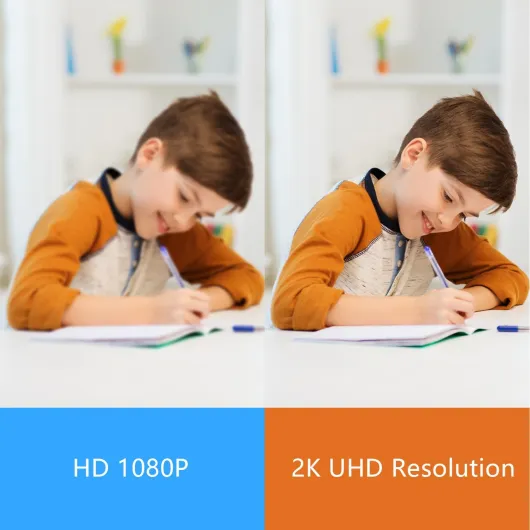
Let’s talk about what really matters: does it record usable footage? Overall, yes. The 1080p image is clear enough to recognize faces and read big text (like a delivery label) at a few meters. It’s not cinema quality, but for a hidden cam, it’s totally fine. During the day or with normal indoor lighting, the picture is sharp and colors are okay. One of the Amazon reviews said it struggles in low light, and I’d say that depends: in very dim conditions it gets grainy and softer, but I could still see what was going on. Don’t expect proper night vision though; there are no IR LEDs, so you rely on ambient light.
The frame rate is around 15–20 fps as advertised. You can see that it’s not super smooth like a 60 fps video, but for monitoring movement, it’s enough. I didn’t have big issues with lag on my 2.4 GHz Wi‑Fi network, as long as the signal was decent. When the signal dropped (one test spot was far from the router), the app sometimes froze or took a few seconds to reconnect, which is pretty standard for cheap Wi‑Fi cameras.
Motion detection is actually one of the better parts. Once I tuned the sensitivity, it picked up people and pets reliably without triggering on every tiny light change. I tested it by walking past the camera at different speeds and also leaving the dog alone. The app pushed notifications in a few seconds, not instant but fast enough. No advanced zoning or smart person detection like high‑end systems, just basic motion on the whole frame, but it does the job.
Audio is usable too. One reviewer said they could hear cars outside; I had a similar experience. Voices in the same room are clear enough to understand, even if there’s a bit of background hiss. It’s not hi‑fi, but for checking what someone said or hearing a baby cry, it’s fine. Overall performance: decent video, acceptable low light, reliable motion alerts, and stable Wi‑Fi as long as your router isn’t miles away. Not mind‑blowing, but totally workable for home monitoring.
What this mini spy cam actually offers (beyond the marketing)
On paper, this module packs a lot: dual 1080p lenses, Wi‑Fi connectivity, motion detection, cloud storage, and support for up to 256 GB microSD. The brand pushes the AI motion detection and dual‑network stuff, but in real life it’s basically a small Wi‑Fi camera with decent motion alerts and the usual 2.4 GHz connection. I didn’t see any magic “AI” behavior, but it does detect people and pets fine and doesn’t spam you too much with random alerts if you set sensitivity properly.
You control everything with an app (generic Chinese‑style security camera app). From there you can:
- Watch live video from both lenses
- Enable/disable motion detection and push notifications
- Switch between cloud and local SD storage
- Change resolution and a few basic settings
The dual‑lens concept is the interesting part. You basically get two tiny cameras on one board, with a slightly wider combined coverage than a normal single‑lens mini cam. In practice, I used one lens aimed at the door and the second pointed toward the living room, both from the same hiding spot inside a decorative box. That part is actually pretty handy: one power source, one module, two views.
So in terms of raw features, it’s fairly complete for a hidden cam: Wi‑Fi, local + cloud, motion alerts, 1080p, app control. Just don’t expect a super polished ecosystem or pro‑level security. It’s more like a flexible little tool for small surveillance projects than a full home security system.
Pros
- Very small and easy to hide, with two separate lenses for wider coverage
- Decent 1080p video quality and reliable motion alerts for basic monitoring
- Supports large microSD cards (up to 256 GB) and can run continuously when plugged in
Cons
- Short internal battery life (around 70–90 minutes) makes it basically a wired camera for real use
- Fragile lens cables and bare module design require careful handling and DIY mounting
Conclusion
Editor's rating
After using the HiSpyCam Dual Lens DIY module for a couple of weeks, my overall feeling is that it’s a good little tool for people who know exactly why they want a hidden camera and don’t mind a bit of DIY. The video quality is decent, the motion alerts work, the Wi‑Fi connection is stable enough, and the dual lens setup really does give you more flexibility in how you cover a room. It’s tiny and easy to hide, which is clearly its main strength.
On the flip side, it’s not a polished consumer gadget. The bare‑bones design, fragile lens cables, short battery life, and basic app mean you need to set your expectations correctly. Treat it like a small electronic module you integrate into a project, not like a finished Nest‑style camera. If you’re okay running a USB cable and carefully mounting it somewhere, it does the job and lines up with that 4.2/5 average rating. If you’re clumsy, hate fiddling with small parts, or just want something you can plop on a table out of the box, this isn’t the best fit.
I’d recommend it to people who want discreet surveillance (nanny cam, pet monitoring, small office corner) and are comfortable with a bit of tinkering. I’d skip it if you need rock‑solid durability, long battery life, or advanced smart features and integrations. For the right use case, it’s pretty solid value; for the wrong one, it’ll just feel like a fiddly little gadget.