Summary
Editor's rating
Is it worth the money compared to other options?
Compact camera, slightly annoying solar connection
Solar support and batteries: this is where things get tricky
Weather resistance and long-term reliability
Video, motion, and app: does the core camera part hold up?
What you actually get (and what you still have to buy)
Pros
- Good 1080p video quality with decent night vision and responsive motion alerts
- Truly wireless install with flexible panel placement up to 2 feet away from the camera
- Solar panel can noticeably extend AA battery life when placed in good sunlight
Cons
- Solar panel reliability is inconsistent; some units stop charging or drain batteries fast
- Fiddly, tight cable connection with rubber seal that’s hard to plug cleanly
- Requires a separate Sync Module 2 and, optionally, subscription or USB storage, increasing total cost

Specifications
View full product page →| Brand | Blink |
A solar-powered camera that sounds easier than it actually is
I’ve been using Blink cameras for a while, so this Outdoor (3rd Gen) with the solar panel mount felt like the logical next step. On paper, it ticks all the boxes: wireless, 1080p, motion detection, solar support so you stop climbing ladders every few months to swap batteries. In reality, it’s a bit more mixed. It works, but you need to know what you’re getting into or you’ll be annoyed pretty quickly.
The first thing to understand: this kit is an add-on camera. You must already have a Blink Sync Module (or buy one separately) or it’s basically a brick. The box doesn’t scream that loudly enough in my opinion. If you’re new to Blink and think this is a complete starter pack, it’s not. You’ll open it, set everything out on the table, and then realize you’re missing the brain of the system.
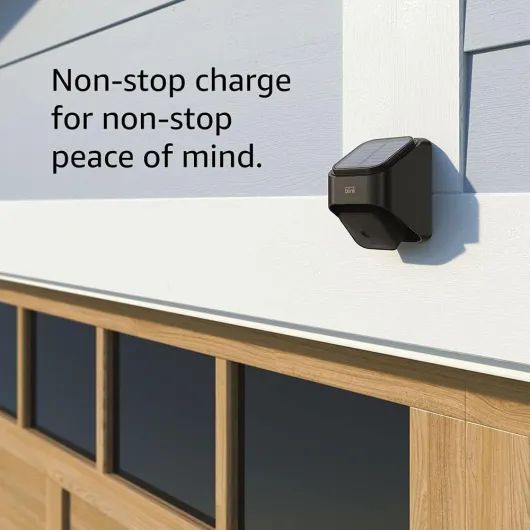
I installed mine on the side of a garage facing a driveway, and I’m checking it mostly from another location. So reliability and battery life matter a lot for me. I don’t want to be that person who has to drive back, bring a ladder, and fiddle with a tiny cable every month because the “solar” part didn’t actually help. The camera itself is pretty solid, the solar mount is where things get a bit more hit-or-miss.
If you’re expecting a fully self-sufficient, zero-maintenance setup, this isn’t that. It can reduce how often you touch the camera, but only if your placement, sun exposure, and settings are dialed in. Otherwise, it turns into a slightly annoying battery-hungry gadget that you’ll keep babysitting. I’ll walk through the good and the bad so you can see if it fits what you actually need, not just what the box suggests.
Is it worth the money compared to other options?
Value-wise, this kit sits in an awkward but usable spot. On one hand, the Blink Outdoor 3rd gen by itself is pretty affordable, and adding a solar mount to reduce battery swaps makes sense if you already own a Sync Module and maybe other Blink cameras. You get wireless installation, no need to run power cables, and the comfort of checking in on your place from anywhere. For that use case, the combo is good value for money, assuming the solar panel behaves and your placement gets enough sun.
On the other hand, once you add up everything—camera + solar mount + Sync Module 2 if you don’t have it + maybe a USB drive or subscription for storage—you’re not that far from other brands that sell fully integrated solar cameras in one box. Some of those options have bigger panels or built-in rechargeable packs designed specifically for solar-only operation. With this Blink combo, you still rely on AA batteries and a somewhat fragile connection, which feels a bit old-school compared to newer designs.
Another thing to factor in is the Amazon rating: around 3.8/5. That’s basically “fine but not great.” The positive reviews often mention good customer service and decent performance when everything is set up right. The negative ones usually slam the solar mount as a battery killer or complain that it stopped charging after some time. That mixed feedback matches my feeling: it’s not junk, but it’s not flawless either, and you’re kind of rolling the dice on how good your particular unit and placement will be.
If you’re already in the Blink ecosystem and you want to cut down, not eliminate, battery changes, the value is acceptable. If you’re starting from scratch and your main goal is a true solar camera that you almost never touch, I’d look around before committing. For me, the value is average: it gets the job done at a reasonable cost, but the compromises and potential headaches stop it from being a clear no-brainer deal.
Compact camera, slightly annoying solar connection
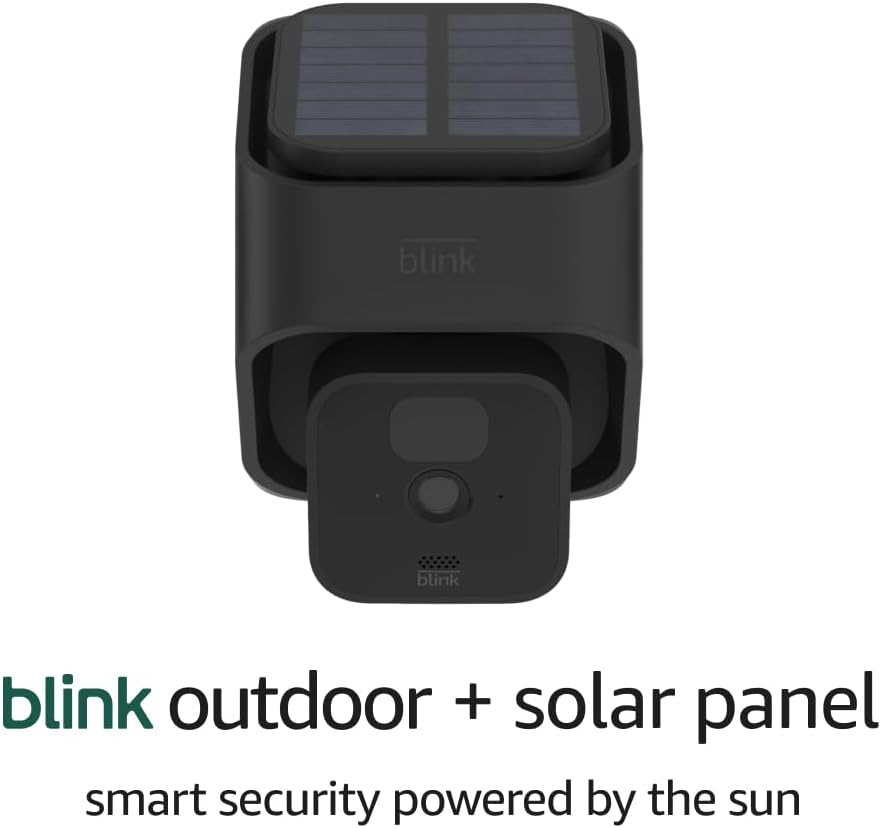
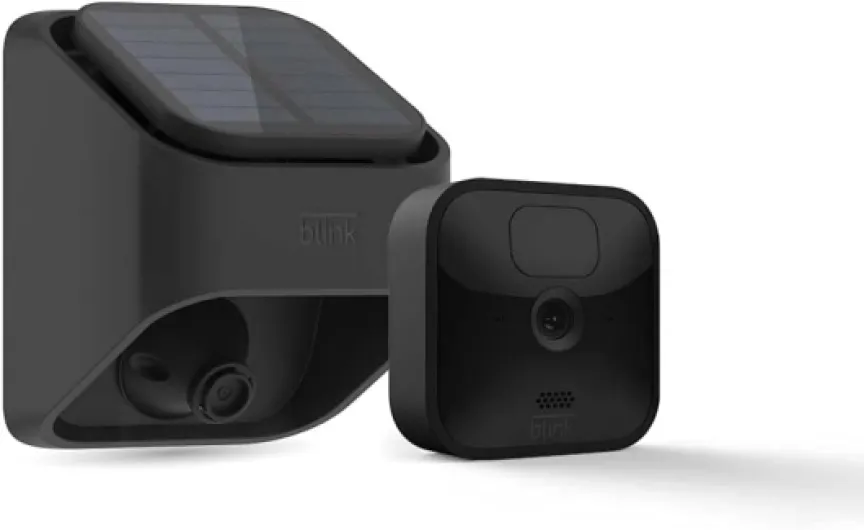
The camera itself is the same Blink Outdoor 3rd gen you see everywhere: small square block, matte black, pretty discreet once it’s up on a wall. It weighs only 48 g and measures 71 x 71 x 31 mm, so it doesn’t look bulky or cheap. It blends in fine on darker siding or brick. The solar mount is the bigger piece, about 140 x 111 x 100 mm and much heavier at 329 g. It feels solid enough to survive outside, but you do notice the weight when you’re on a ladder trying to hold it in place and drill at the same time.
The design idea is decent: the camera sits in a housing that’s attached to the solar panel mount. You can pivot the panel to catch the sun, or detach it and mount it up to two feet away using the included mount and cable. That flexibility matters a lot if your ideal camera angle isn’t the same as your best sun angle. In my case, I had to angle the panel slightly off from the camera so it’d actually get full sun part of the day.
Where the design falls short is the cable connection between the panel and the camera. The plug goes into a tiny port on the back of the camera through a small cutout in the housing. There’s a tight rubber seal that’s supposed to keep water out. In practice, that seal makes it a pain to plug the cable fully without feeling like you’re about to damage the connector or the port. One of the reviewers described this as nearly impossible without forcing it, and I get what they mean. If you’re not patient, you’ll be swearing at a piece of rubber for a few minutes.
Overall, the design is functional but not exactly friendly. Once it’s installed and connected correctly, you forget about it visually and it looks fine on a wall. But the first install is more fiddly than it should be, especially if you’re trying to do a clean, sealed connection on a ladder. I’d say the camera design is pretty solid, the solar mount design is okay but could really use a better, more forgiving connector system.
Solar support and batteries: this is where things get tricky
This is the part you really need to understand before buying. The camera uses two AA 1.5V lithium metal batteries (non-rechargeable) and the solar panel mount has its own internal rechargeable 18650 battery. The idea is that the solar panel charges its internal battery during the day, which then powers the camera and helps the AA batteries last longer. It does not turn the camera into a fully solar-only system that magically refills the AAs. If you go in with the wrong expectations, you’ll think the product is broken.
In practice, the experience is mixed. Some users, and I’m in that group, see a clear benefit: with decent sunlight and moderate motion activity, the camera keeps going for several months with no battery swaps. The internal solar battery keeps things topped up enough that the AAs drain slowly. That’s pretty much what I wanted: fewer ladder trips, not zero. But if your panel doesn’t get solid sun (north-facing wall, lots of shade, bad angle), the solar mount won’t do much. You’ll burn through AAs like a normal Blink cam, and you’ll wonder why you paid extra.
On the negative side, there are several reports of the solar charger becoming unreliable after some months. One review said it stopped charging after about a year, another said batteries died in a week and motion stopped working until they got a replacement panel from customer support. Another person mentioned the solar mount seemed to kill both regular and rechargeable batteries and called it junk. The common complaint is that when the solar part acts up or the connection is poor, the camera just drains whatever batteries you put in and you’re stuck constantly swapping them.
From my own use and reading others, I’d say: the concept is good but fragile. If you place the panel well, use the recommended Energizer lithium AAs, keep motion settings reasonable, and you’re okay with replacing AAs every so often, it’s fine. If you expect a fully hands-off solar camera or you have a bad sun location, you’ll be disappointed. Also, the tight cable seal makes it easy to not fully seat the connector, which can cause weird power behavior. So yes, it can extend battery life, but it’s not bulletproof, and some units clearly have reliability issues over time.
Weather resistance and long-term reliability
On the weather side, the camera and mount are rated to handle -4 to 113°F, which covers most climates unless you’re in extreme conditions. I’ve had mine outside through rain, heat, and a bit of frost, and the housing hasn’t cracked or faded. The plastic doesn’t feel luxury-level, but it doesn’t feel brittle either. It’s the same kind of build Blink has used for years, and those cameras generally survive outdoors if you don’t abuse them.
One long-term user in the reviews said they’ve had the camera and solar panel running for several years with no major issues. That lines up with my impression that the physical hardware (case, mount, bracket) is reasonably tough. You might need to wipe the panel and lens every now and then to clear dust or pollen, but that’s normal for anything sitting outside. As long as it’s mounted securely, it doesn’t wobble or feel like it’s about to fall apart in wind.
Where durability is more questionable is the internal electronics of the solar panel and the power connection. Multiple people report the solar charging becoming unreliable after months: panels that stop charging, weird behavior with batteries, or motion issues that only go away after replacing the solar mount. Blink’s customer support does seem pretty responsive—several reviewers got replacement panels sent out fairly quickly—but that still means you’re dealing with downtime and reinstallation.
So, I’d split durability into two parts: physical durability is good for the price, no major complaints there. Long-term electronic reliability of the solar system is more hit-and-miss. If you get a good unit and mount it well, you’re probably fine for the long run. If you’re unlucky and get a flaky panel, you might end up doing troubleshooting with support and swapping hardware, which kind of kills the whole “low maintenance” idea. Overall, decent durability but not something I’d blindly trust without keeping an eye on battery levels in the app.
Video, motion, and app: does the core camera part hold up?
On the camera side, it does what it says. Daytime image quality in 1080p is clear enough for normal home use: you can see faces, license plates at short range, and general activity without squinting. Night vision is infrared, so it’s black and white, but it’s still fairly sharp. You’re not getting cinema-level detail, but for checking who’s at the driveway or if a package was dropped off, it’s totally fine. Frame rate goes up to 30 fps, and I didn’t notice any weird stuttering unless my Wi-Fi was acting up.
Motion detection is decent but needs tuning in the app. Out of the box, it can be a bit trigger-happy with cars, shadows, and branches, especially if the camera faces a busy street. The app lets you set motion zones and sensitivity, and that helps a lot. Once I dialed it back and excluded the road, the alerts became more relevant. One of the reviews mentioned motion not working after some battery issues, but in my case, motion was stable once the system was powered correctly and armed in the app.
The app itself is straightforward. You get notifications fairly quickly after motion events, clips load reasonably fast, and Live View works as long as the Wi-Fi at the camera location is solid. I tested remote access from another city, and it behaved fine. Just remember, this is not a continuous recording system. It records short clips when motion is detected, with options for how long each clip is and how long to wait before recording again. If you want full-time recording, this product is not made for that.
Overall, in terms of pure camera performance—video, audio, motion, app responsiveness—it’s pretty solid for the price range. No real surprises, good or bad. It’s not blowing away higher-end wired systems, but as a wireless battery cam, it gets the job done. Most of the frustration people have online isn’t about the image or the motion itself; it’s about the power and battery behavior, which is where the solar part enters the story.
What you actually get (and what you still have to buy)
Out of the box, you get: one Blink Outdoor 3rd gen camera, the solar panel mount with its built-in rechargeable 18650 battery, a housing cover, a mounting kit, and a little right-angle adapter for the cable. The camera itself also comes with two non-rechargeable AA lithium batteries. That last detail is important, because some people assume the solar panel will magically recharge those AAs. It doesn’t. The panel charges its own internal battery, which then powers the camera through the cable, mainly to extend the life of the AAs, not replace them forever.
The big missing piece is the Sync Module 2. This kit doesn’t include it, and Blink doesn’t exactly tattoo that on the front of the packaging. You need that module to connect the camera to Wi-Fi and handle all the communication. If you already have other Blink cameras, no problem, it just joins the existing system. If this is your first Blink product, factor in the extra cost and the extra box to plug into your router area.
Feature-wise, it’s the usual Blink package: 1080p HD video, infrared night vision, 110° field of view, two-way audio, motion detection, and alerts on your phone through the Blink Home Monitor app. It supports Alexa, but keep in mind it’s a clip-based system, not 24/7 continuous recording. You can store clips in the cloud with a subscription after the free trial, or locally with a USB drive plugged into the Sync Module 2. None of that is complicated, but it’s more “bits and pieces” than a single all-in-one box.
In practice, the product is basically: a normal Blink Outdoor cam plus a solar cradle that tries to keep it running longer. If you already like Blink and just want to stretch battery life without running power cables, this setup makes sense. If you’re starting from zero and want a completely plug-and-play solar camera that never needs attention, there are simpler all-in-one options on the market. This one leans more toward people already in the Blink ecosystem and okay with a bit of tinkering.
Pros
- Good 1080p video quality with decent night vision and responsive motion alerts
- Truly wireless install with flexible panel placement up to 2 feet away from the camera
- Solar panel can noticeably extend AA battery life when placed in good sunlight
Cons
- Solar panel reliability is inconsistent; some units stop charging or drain batteries fast
- Fiddly, tight cable connection with rubber seal that’s hard to plug cleanly
- Requires a separate Sync Module 2 and, optionally, subscription or USB storage, increasing total cost
Conclusion
Editor's rating
Overall, the Blink Outdoor (3rd Gen) with the Solar Panel Charging Mount is a decent wireless security setup if you go in with realistic expectations. The camera itself is solid for the price: clear enough 1080p video, reliable motion detection once tuned, and a simple app that lets you manage everything remotely. For basic home monitoring—driveways, yards, side doors—it does the job without needing a power outlet nearby.
The weak spot is the solar mount. In the best-case scenario, with good sun and sensible motion settings, it definitely extends your AA battery life and cuts down how often you need a ladder. In the worst-case scenario—shady placement, high motion, or a flaky panel—you end up burning through batteries and fighting with a stiff cable connection that never feels quite right. The mixed Amazon rating around 3.8/5 reflects that split: some people happy, some people fed up.
I’d say this kit is for people who already own a Blink system, understand how Blink works (clip-based, not 24/7), and want to stretch battery life a bit without running wires. It’s not for someone who wants a totally hands-off, fully solar, install-and-forget camera or for someone just starting out who hasn’t bought a Sync Module yet. If you’re okay with checking battery levels in the app every now and then and you have a sunny wall or post to mount it on, it’s a reasonable choice. If you hate troubleshooting and your yard is mostly shade, you’ll probably be happier with a different brand or a wired solution.